
AI is no longer something Gen Alpha only uses to answer questions or get help with homework.
It can now talk back, remember conversations, tell jokes, role-play characters, give advice, and sometimes even feel like a friend.
These systems are known as AI companions.
For Gen Alpha—the first generation growing up with conversational AI as a normal part of everyday technology—the idea of talking to an AI may not feel strange at all.
An AI can be a homework helper in the afternoon, a gaming or creative assistant later, and someone to talk to when you’re bored at night.
But that creates an important question:
When does AI stop being just a tool and start feeling like a relationship?
Whether you’re a young person using AI, a parent trying to understand it, or an educator watching these technologies enter students’ lives, here’s what you should know about AI companions for kids and Gen Alpha.
Table of Contents
What Is an AI Companion?
An AI companion is a chatbot designed to have ongoing, personalized conversations that can feel social or relational.
It might remember things you have previously discussed, adapt to your interests, respond to your emotions, or develop a particular personality.
Some AI companions can even be customized with:
- Names
- Avatars
- Voices
- Personalities
- Interests
- Fictional characters
That can make talking to one feel very different from using a traditional search engine.
But there is one important thing every Gen Alpha user should remember:
AI can sound human without being human.
An AI does not experience friendship, happiness, sadness, loneliness, love, or empathy in the same way you do.
Why AI Companions Matter for Gen Alpha
Gen Alpha is growing up during a technological shift that previous generations never experienced as children.
Millennials grew up alongside the web.
Gen Z grew up alongside smartphones and social media.
Gen Alpha is growing up alongside artificial intelligence that can communicate with them directly.
That distinction matters.
AI is moving from something children simply use to something they can interact with.
A chatbot can answer.
Remember.
Respond.
Create.
Give advice.
And maintain a conversation.
For some young users, that may make AI feel less like software and more like a social presence.
If you want to understand the wider technological habits shaping this generation, explore our latest Generation Alpha statistics for 2026.
How Gen Alpha May Use AI Companions
Not every conversation with AI is about loneliness or emotional support.
Gen Alpha can use conversational AI in many different ways.
For Creativity
AI can help brainstorm characters, stories, games, art concepts, videos, and imaginary worlds.
Instead of asking AI to create everything, young users can use it as a brainstorming partner and then develop their own ideas.
For Learning
Young users can ask AI to explain difficult concepts, practice languages, brainstorm project ideas, or quiz them before a test.
AI can also support schoolwork when used responsibly. Read our guide on whether children should use ChatGPT for homework.
For Entertainment
Some people simply enjoy talking to fictional AI characters or creating funny conversations.
For Gen Alpha, interacting with AI may increasingly become another form of digital entertainment alongside gaming, videos, and social media.
For Practicing Conversations
AI can provide a low-pressure environment for practicing interviews, presentations, difficult conversations, or another language.
For Advice
This is where things become more complicated.
Young people may ask AI questions about friendships, relationships, school problems, appearance, emotions, family, or their future.
For Companionship
Some users may talk to AI because they are bored, lonely, stressed, or simply want someone—or something—to respond immediately.
And that’s where understanding the difference between using AI and depending on AI becomes important.
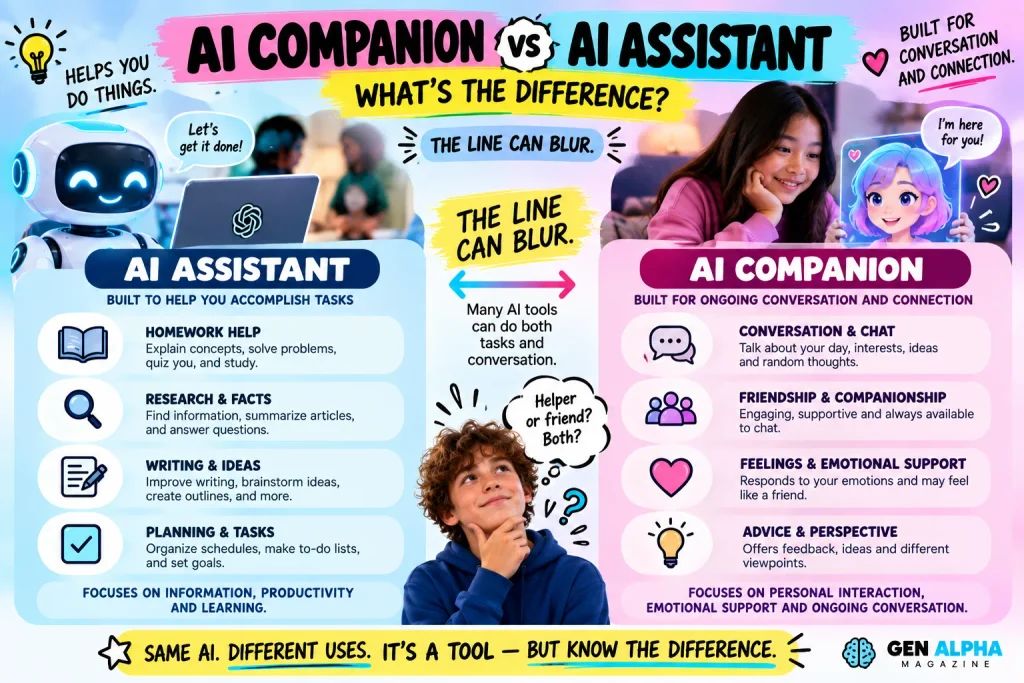
AI Companion vs AI Assistant: What’s the Difference?
An AI assistant primarily helps you accomplish something.
Think:
“Help me understand this math problem.”
“Give me ideas for my science project.”
“Help me organize my study schedule.”
An AI companion is more focused on conversation or connection.
Think:
“I had a terrible day.”
“Can I tell you something?”
“Nobody understands me.”
“What should I do about my friend?”
But the line can blur.
The same AI you use for homework could become something you regularly talk to about your life.
That is why knowing how AI works is becoming an important part of AI literacy for Gen Alpha.
Are Kids Actually Using AI for Personal Conversations?
AI use among young people is no longer limited to homework.
Children and teens are increasingly encountering conversational AI in education, search, apps, entertainment, games, and other digital experiences.
Some young people also use AI to ask questions they may feel uncomfortable asking another person.
That doesn’t mean every child using a chatbot considers it a friend.
There is a major difference between occasionally asking an AI for advice and developing a strong emotional attachment to it.
Understanding that difference will become increasingly important as conversational AI becomes more common.
The Good Side of AI Companions
AI companions are not automatically bad.
Used thoughtfully, conversational AI can be useful.
It may help young people:
- Brainstorm ideas
- Practice conversations
- Develop stories
- Explore interests
- Practice another language
- Prepare for presentations
- Think through different perspectives
- Ask questions they feel embarrassed asking initially
The key word is tool.
AI can help you think.
It should not do all your thinking for you.
And it should not become the only place you go when something important happens.
If you’re looking for AI focused more on learning and productivity, explore our guide to the best safe AI tools for students in 2026.
If You’re Gen Alpha, Remember These 5 Things About AI Friends
1. AI Can Sound Like It Cares
An AI might say:
“I understand you.”
“I’m here for you.”
“You can always talk to me.”
Those sentences can feel comforting.
But AI generates responses. It does not experience emotions the way another person does.
That doesn’t mean the conversation is useless.
It means you should understand what is actually happening.
2. Don’t Tell AI Everything
Talking to an AI may feel private.
That doesn’t mean you should treat it like a secret diary.
Don’t casually share:
- Your password
- Home address
- Exact location
- School schedule
- Financial details
- Private photos
- Sensitive medical information
- Deeply private information about other people
A useful rule is:
If you wouldn’t want the information stored online, think twice before telling it to an AI.
AI privacy is only one part of digital safety. Young users and families should also understand the wider principles of keeping children safe online.
3. AI Can Be Wrong
AI can give an answer that sounds incredibly confident.
And still be completely wrong.
For homework, verify important facts.
For serious health, safety, relationship, or emotional problems, talk to a trusted human.
A confident AI answer is not automatically a correct answer.
4. Your Real Friends Won’t Always Agree With You
AI can be incredibly agreeable.
Real people aren’t.
And that’s actually important.
Friendships teach you how to listen, disagree, apologize, compromise, understand someone else’s feelings, and repair relationships.
Those experiences are part of growing up.
5. AI Should Add to Your Life, Not Replace It
Talking to AI occasionally is very different from needing it constantly.
Ask yourself:
Am I using AI because it’s useful—or because I don’t want to talk to anyone else?
That is an important distinction.
Healthy AI use is also part of the broader conversation around screen time and digital balance for children.
Could Gen Alpha Become the AI Companion Generation?
Possibly—but it is too early to know exactly how these technologies will shape childhood.
What we can already see is that Gen Alpha’s relationship with AI will likely be different from that of previous generations.
For an adult, talking to a computer about feelings may still seem unusual.
For a child who grows up surrounded by conversational AI, it may feel completely normal.
That normalization creates opportunities.
AI could become a powerful learning, accessibility, creativity, and communication tool.
But it also creates new questions about:
- Privacy
- Emotional attachment
- Human relationships
- Misinformation
- Persuasive technology
- Mental health
- Digital identity
Gen Alpha will not simply need to learn how to use AI.
They will need to learn how to live alongside AI without confusing artificial relationships with human ones.
AI Friends vs Real Friends
An AI friend can respond almost instantly.
A real friend might take an hour.
An AI may let you talk about yourself endlessly.
A real friend needs you to listen too.
An AI may rarely become annoyed.
A real friend will sometimes disagree with you.
That can make AI friendship seem easier.
But easier does not necessarily mean better.
Real friendship is mutual.
Both people have emotions, needs, experiences, and boundaries.
That complexity is part of what makes human relationships meaningful.
A Quick Check for Young AI Users
If you regularly talk to an AI companion, ask yourself:
Do I still enjoy spending time with real friends and family?
Would I rather tell the AI something important than any person I trust?
Am I giving the AI private information?
Do I believe everything it tells me?
Would I follow its advice about something serious?
Would I feel extremely upset if I couldn’t access it?
There is no need to panic because you enjoy chatting with AI.
These questions simply help you notice how the technology fits into your life.
For Parents: Don’t Only Ask “How Much AI?”
Ask:
“What are you using AI for?”
There is a major difference between a child spending 30 minutes using AI to brainstorm a story and spending 30 minutes telling an AI companion things they feel unable to tell another person.
Understanding the purpose of AI use can sometimes be more important than simply measuring the minutes.
Parents can also try the AI systems their children use.
Ask questions.
Test the responses.
Look at the privacy settings.
Understand why your child finds the technology interesting.
That creates a better foundation for conversations about safety.
What Information Should Kids Never Share With an AI Companion?
Children and young people should be cautious about sharing sensitive personal information with any AI system.
This includes:
- Passwords
- Home addresses
- Exact real-time locations
- School schedules
- Financial information
- Private photos
- Sensitive health information
- Family secrets
- Other people’s private information
It is especially important to remember that another person’s information isn’t yours to give away.
For example, don’t upload a friend’s private messages to an AI chatbot without considering their privacy.
Young people should think of AI privacy as part of their broader online safety.
What If an AI Gives You Serious Advice?
This is where young AI users need a simple rule:
AI can help you think, but important decisions should involve humans.
If an AI conversation involves serious questions about health, mental health, personal safety, bullying, relationships, medication, money, or another major life issue, involve someone you trust.
That might be:
- A parent
- Teacher
- School counselor
- Doctor
- Qualified professional
- Another trusted adult
AI can provide information.
It cannot take responsibility for what happens in your life.
Can AI Companions Replace Mental Health Support?
No.
An AI chatbot may generate supportive language, but it should not be treated as a replacement for a qualified mental health professional.
This distinction is particularly important for young people.
If something feels too serious, frightening, overwhelming, or difficult to handle alone, talk to a trusted person.
AI can be part of a conversation.
It should not become the entire support system.
The Bigger Gen Alpha Question
The rise of AI companions is part of a much bigger story.
Generation Alpha is growing up with technology that increasingly behaves less like a machine and more like an interactive presence.
AI may become a tutor.
A creative partner.
A gaming character.
An assistant.
A coach.
And perhaps, for some young people, something they consider a friend.
The challenge for Gen Alpha will not simply be learning how to prompt AI effectively.
It will be learning something much bigger:
When should I use technology, and when do I need another human being?
That may become one of the most important digital-literacy skills of their generation.
Frequently Asked Questions About AI Companions for Kids
What are AI companions for kids?
AI companions are conversational AI systems designed to have personalized, ongoing interactions with users.
Unlike basic AI tools that mainly answer questions or complete tasks, AI companions may remember conversations, respond to emotions, role-play characters, give advice, and simulate friendship or social connection.
Are AI companions safe for kids?
AI companions are not equally safe for every child or situation.
Potential concerns include privacy, inaccurate advice, inappropriate content, emotional attachment, and children misunderstanding the difference between simulated empathy and genuine human emotion.
Parents should check the specific platform, its age requirements, privacy practices, and safety controls.
Are AI companions popular with Gen Alpha?
Conversational AI is becoming increasingly relevant to Gen Alpha as young people use AI for learning, creativity, entertainment, advice, and personal conversations.
AI companions are particularly significant for Gen Alpha because this is the first generation growing up with human-like conversational AI as part of everyday digital life.
Our Generation Alpha statistics for 2026 provide a broader look at how technology is shaping this generation.
Can AI really be a friend?
AI can simulate some behaviors associated with friendship.
It can listen, remember information, respond supportively, and maintain conversations.
However, an AI does not experience emotions or participate in a mutual relationship the way a human friend does.
It may feel friendly without actually experiencing friendship.
Why do kids talk to AI companions?
Kids may use AI companions because they are entertaining, instantly available, personalized, and easy to talk to.
Some young people may use them for creativity or role-playing, while others may ask for advice, discuss their day, or talk about feelings.
What’s the difference between an AI companion and an AI assistant?
An AI assistant is primarily designed to help accomplish tasks such as researching, writing, studying, planning, or answering questions.
An AI companion places greater emphasis on conversation, personality, emotional interaction, or an ongoing relationship.
However, the distinction is becoming less clear because some AI systems can perform both roles.
Understanding this difference is one part of developing better AI literacy.
Can Gen Alpha use AI companions for learning?
Yes.
Conversational AI can potentially help young people brainstorm ideas, practice languages, role-play situations, prepare for presentations, explore interests, and understand difficult concepts.
Young users should still verify important information because AI can make mistakes.
For education-focused options, see our guide to the best safe AI tools for students.
Can AI companions help with loneliness?
Talking to an AI may temporarily make someone feel less alone, but an AI companion should not become a replacement for real friendships, family relationships, community, or professional support.
If a young person is experiencing persistent loneliness or emotional difficulties, connecting with a trusted human is especially important.
Can AI companions give advice?
Yes, AI companions can generate advice about many subjects.
That does not mean the advice is always accurate, appropriate, or safe.
Gen Alpha users should be especially careful about relying on AI for serious decisions involving health, mental health, safety, relationships, medication, money, or other important areas.
What information should kids never share with an AI companion?
Young users should avoid unnecessarily sharing sensitive information such as passwords, home addresses, precise locations, financial details, school schedules, private photos, medical information, and other people’s confidential information.
A chatbot may feel private, but it should not automatically be treated like a private diary.
Can AI companions replace real friends?
They should not.
AI can provide conversation and simulate social interaction, but real friendships involve mutual feelings, responsibilities, disagreements, empathy, boundaries, and shared experiences.
Those experiences are important parts of growing up.
Can AI companions replace therapists?
No.
An AI companion should not be treated as a replacement for a qualified mental health professional.
If a child or young person is struggling with serious emotional, behavioral, or mental health concerns, a trusted adult and appropriate professional support should be involved.
What are the warning signs of unhealthy AI companion use?
Parents and young users should pay attention if AI begins replacing real-world relationships, a child becomes extremely distressed without access to the chatbot, sensitive personal information is repeatedly shared, serious decisions depend heavily on AI advice, or conversations with the AI are being deliberately hidden.
One sign alone does not necessarily mean there is a problem.
The overall pattern and context matter.
Should parents ban AI companions?
A blanket ban may not always be the most useful approach.
Parents can first understand which AI service their child is using, why they use it, what conversations they are having, and what safety and privacy controls are available.
Open conversations about AI may help children develop better long-term digital habits.
How can Gen Alpha use AI companions more safely?
Young users can treat AI as a tool rather than a replacement for people.
Protect personal information, question the answers AI provides, verify important information, maintain real-world friendships, and involve a trusted adult when conversations involve serious health, safety, emotional, or personal issues.
Learning good online safety habits can also help young people navigate AI and other digital platforms more responsibly.
Will AI companions become normal for Gen Alpha?
They may become increasingly common as conversational AI appears in apps, games, education tools, devices, toys, and other digital experiences.
Exactly how this will affect Gen Alpha’s relationships and development is still being studied.
What is already clear is that understanding the difference between human interaction and AI simulation will be an increasingly important digital-literacy skill.
Final Thoughts
AI companions could become a significant part of Gen Alpha’s digital world.
That does not mean they should automatically be feared.
It also does not mean they should be treated like ordinary apps.
Technology that can talk, remember, personalize, advise, and simulate empathy deserves a different level of awareness.
For Gen Alpha:
Use AI. Explore it. Create with it. Learn from it. But remember what it is.
For parents:
Stay curious about how your child uses AI rather than focusing only on banning or controlling it.
And for everyone:
AI can be an incredibly powerful tool.
But when you need genuine care, accountability, friendship, professional help, or someone who truly knows you, humans still matter.