
Generation Alpha is the name commonly given to the generation born after Generation Z. Its members are growing up in a world shaped by smartphones, streaming platforms, online learning, artificial intelligence and rapidly changing technology.
But what is Generation Alpha exactly, which years belong to it, and what makes this generation different?
A widely used definition describes Generation Alpha as people born from 2010 to 2024. However, generational boundaries are not official laws or fixed scientific categories. Different researchers may use slightly different years. These labels are mainly used to understand broad social, cultural and technological changes—not to predict the personality of every child.
This beginner-friendly guide explains the Generation Alpha age range, meaning, characteristics, parents, education and possible future. It also offers a balanced perspective for parents and teachers without assuming that technology alone defines every child.
What Does Generation Alpha Mean?
Generation Alpha, also called Gen Alpha, is the demographic group that follows Generation Z.
Social researcher Mark McCrindle is widely credited with introducing the name. After Generation X, Generation Y and Generation Z, he selected “Alpha,” the first letter of the Greek alphabet, to represent the beginning of a new generational cycle.
The name is therefore not intended to mean that these children are superior, dominant or “alpha personalities.” It simply signals a fresh starting point after the end of the Latin alphabet labels used for previous generations.
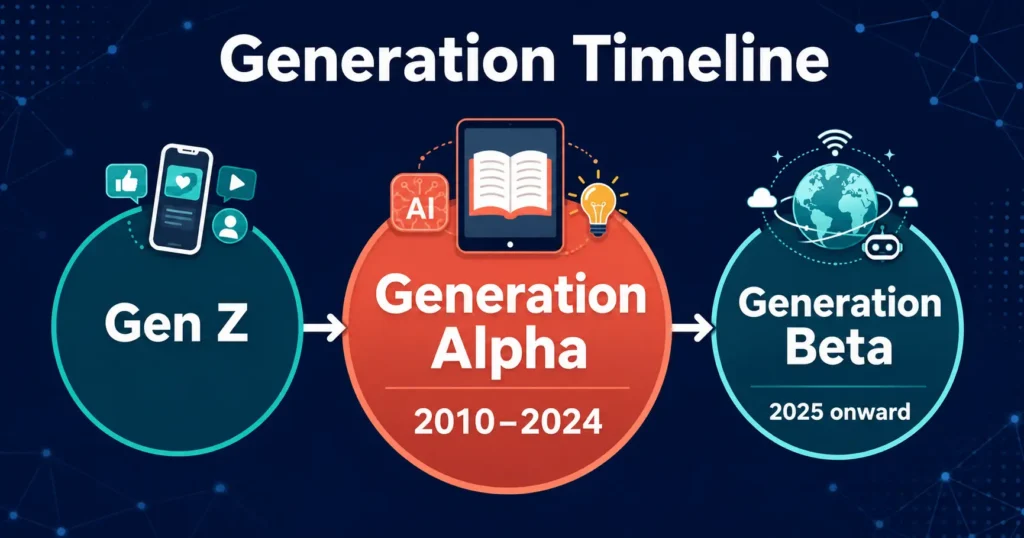
McCrindle defines Generation Alpha as people born between 2010 and 2024. Under this definition, Generation Beta follows from 2025 onward. McCrindle Research
What Years Are Generation Alpha?
The most frequently cited Generation Alpha years are:
2010 to 2024
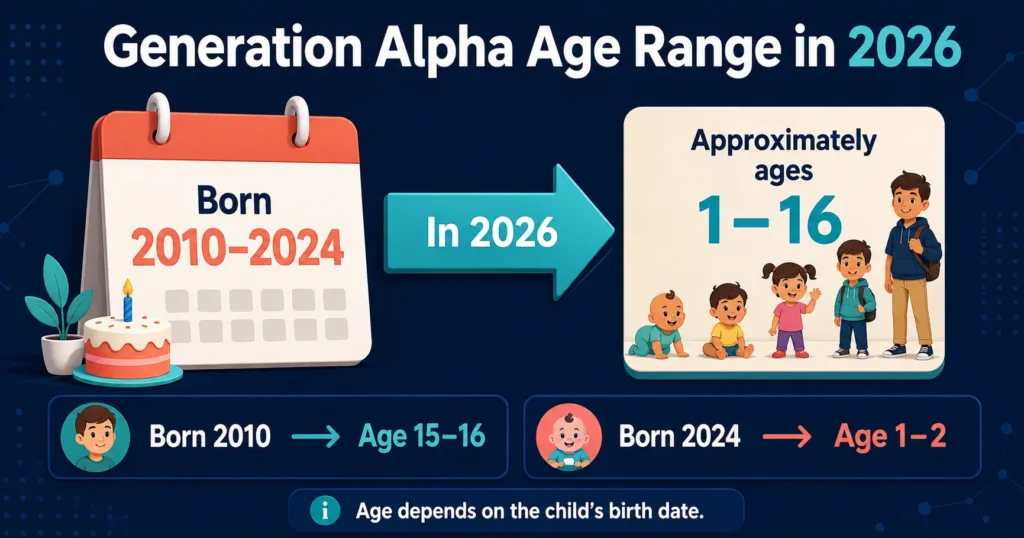
Using this definition, the oldest members of Gen Alpha turn 16 during 2026, while the youngest are babies or toddlers. This means Generation Alpha currently includes children at many different developmental stages—from early childhood to the teenage years.
It is important to remember that researchers do not universally agree on exact generational boundaries. Some sources may begin Generation Alpha a little later or use a different ending year.
There is no official international organization that assigns every person to a generation. Generational labels are tools researchers, educators, businesses and media organizations use to discuss broad patterns. A person born near a boundary year may also relate to characteristics associated with both neighbouring generations.
Generation Alpha Age Range in 2026
People born from 2010 through 2024 are approximately 1 to 16 years old in 2026, depending on their birth month.
| Birth year | Approximate age in 2026 |
|---|---|
| 2010 | 15–16 |
| 2011 | 14–15 |
| 2012 | 13–14 |
| 2013 | 12–13 |
| 2014 | 11–12 |
| 2015 | 10–11 |
| 2016 | 9–10 |
| 2017 | 8–9 |
| 2018 | 7–8 |
| 2019 | 6–7 |
| 2020 | 5–6 |
| 2021 | 4–5 |
| 2022 | 3–4 |
| 2023 | 2–3 |
| 2024 | 1–2 |
Because most members are still children, many claims about their eventual careers, values and adult behaviour remain predictions. Their defining experiences will become clearer as they grow older.
Who Are Generation Alpha’s Parents?
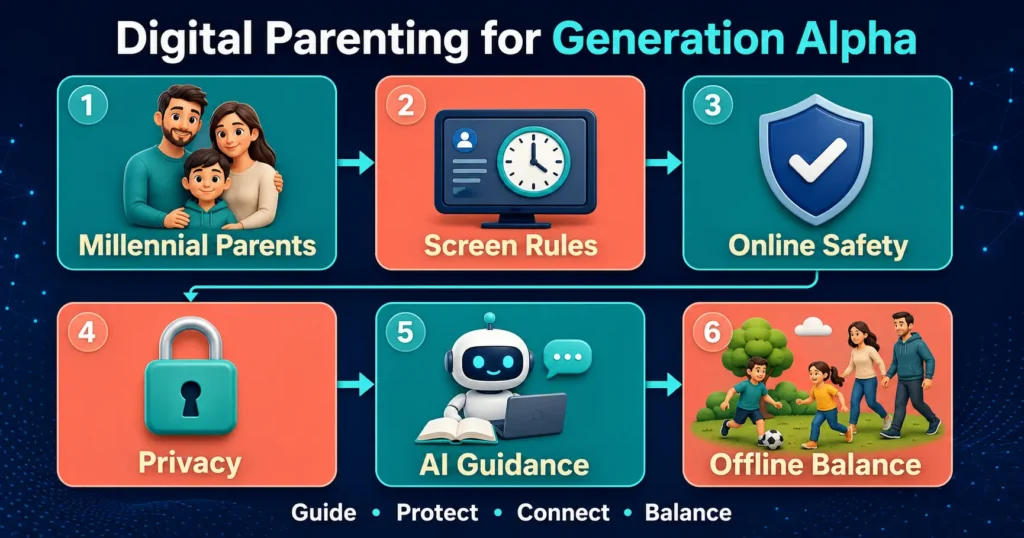
Many Gen Alpha children are being raised by Millennial parents, although some have parents from Generation X or Generation Z.
Millennials grew up during the expansion of the internet, mobile phones and social media. As parents, they are raising children in a more connected environment than the one they experienced during early childhood.
This can create new parenting questions, such as:
- When should a child receive a first phone?
- How much screen use is appropriate?
- Which applications and games are safe?
- How can children use AI responsibly?
- How should families protect children’s personal information?
- How can online learning be balanced with physical activity and offline play?
These questions help explain why digital parenting has become an important subject for families raising Generation Alpha.
What Makes Generation Alpha Different?
No single list can describe every member of such a large and diverse global population. Children’s lives are influenced by their country, language, culture, family income, education, health, access to technology and many other factors.
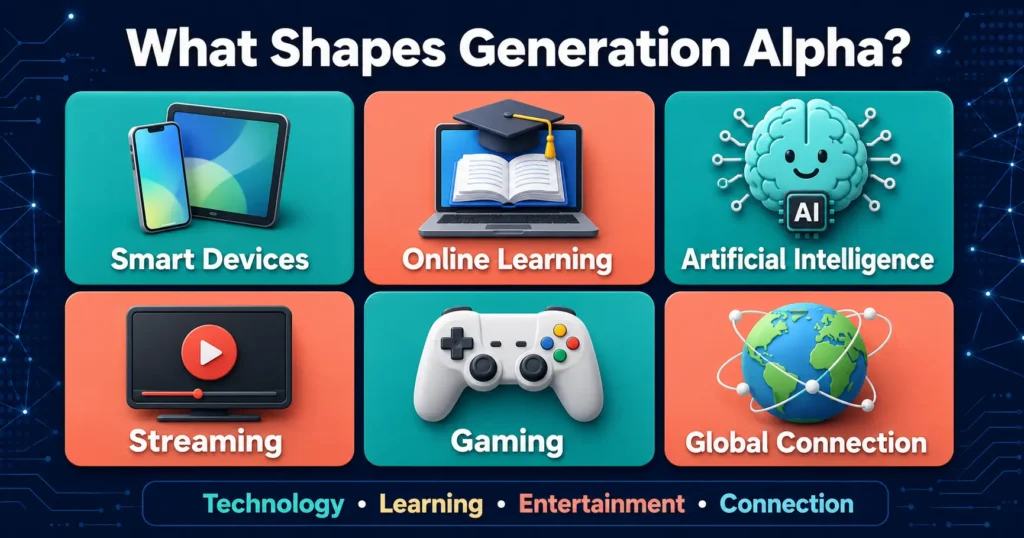
Nevertheless, several shared developments may influence many members of Generation Alpha.
1. They Are Growing Up With Digital Technology
Generation Alpha is the first generation whose members were all born during the 21st century. Many have encountered touchscreens, video calls, streaming services and smart devices from an early age.
For some children, digital technology is part of school, entertainment, communication and family life. They may switch naturally between printed books, videos, interactive games and educational applications.
However, access is not equal. Some children have several personal devices and fast internet, while others have limited or no reliable connectivity. It is therefore misleading to assume that every Gen Alpha child has the same level of digital access or skill.
Technology use should also not be confused with technology understanding. A child may know how to watch videos or play games without understanding privacy, misinformation, advertising or how an algorithm influences what appears on the screen.
2. Artificial Intelligence Is Becoming Part of Their Education
AI-powered tools are appearing in search engines, learning applications, writing assistants, chatbots and creative software. As Generation Alpha moves through school, many students will need to learn both how to use AI and how to question it.
Useful AI literacy includes understanding that an AI system can:
- Produce incorrect information
- Reflect bias present in its data
- Generate convincing but false images or text
- Collect or process personal information
- Assist learning without replacing independent thinking
Parents and teachers can encourage children to verify AI-generated answers, protect private information and use technology as a learning aid rather than a shortcut.
UNICEF’s Digital Education Strategy 2025–2030 emphasizes evidence-based digital learning, improved educational outcomes and greater access for underserved children. This supports a balanced approach in which technology serves learning instead of being treated as the goal itself. UNICEF Digital Education Strategy
3. Their Education May Become More Personalized
Generation Alpha students are experiencing a mixture of traditional classroom teaching and digital learning. Depending on the school and location, this may include educational applications, video lessons, interactive exercises, digital assessments and AI-assisted feedback.
These tools can allow students to practise at an appropriate pace and receive extra support. However, digital tools cannot replace every part of education.
Children still benefit from qualified teachers, discussion, cooperation, creativity, physical activity and real relationships. Effective education should use technology where it improves learning while preserving the human experiences necessary for development.
4. Online and Offline Life Are Closely Connected
For many older Gen Alpha children, online games and digital platforms are not simply forms of entertainment. They can also be places for creativity, communication and shared experiences.
A child might design something in a game, discuss it with friends at school and later watch a related video at home. The separation between “online life” and “real life” is therefore less clear than it was for earlier generations.
This connection creates opportunities for learning and creativity, but it also introduces risks involving privacy, inappropriate content, scams, cyberbullying and contact with strangers.
UNICEF reports that harmful online experiences such as bullying and abuse are more clearly connected with poor mental-health outcomes than screen time alone. Its research recommends focusing on safe platforms, age-appropriate use, digital skills and protection from harmful experiences—not relying only on a simple count of hours online. UNICEF: Childhood in a Digital World
5. They Experienced the Effects of the COVID-19 Pandemic
Members of Generation Alpha experienced the pandemic at different stages of childhood. Some were infants, while others attended school remotely or faced disruptions to normal classroom routines.
The effects were not the same for every child. Experiences varied according to location, family circumstances, access to devices, school support and the severity of local restrictions.
For some families, the period increased familiarity with online education and video communication. For others, it highlighted inequalities in internet access, learning support and suitable spaces for study.
The pandemic may remain one of this generation’s important shared historical events, but researchers will need more time to understand its long-term influence.
Common Generation Alpha Characteristics
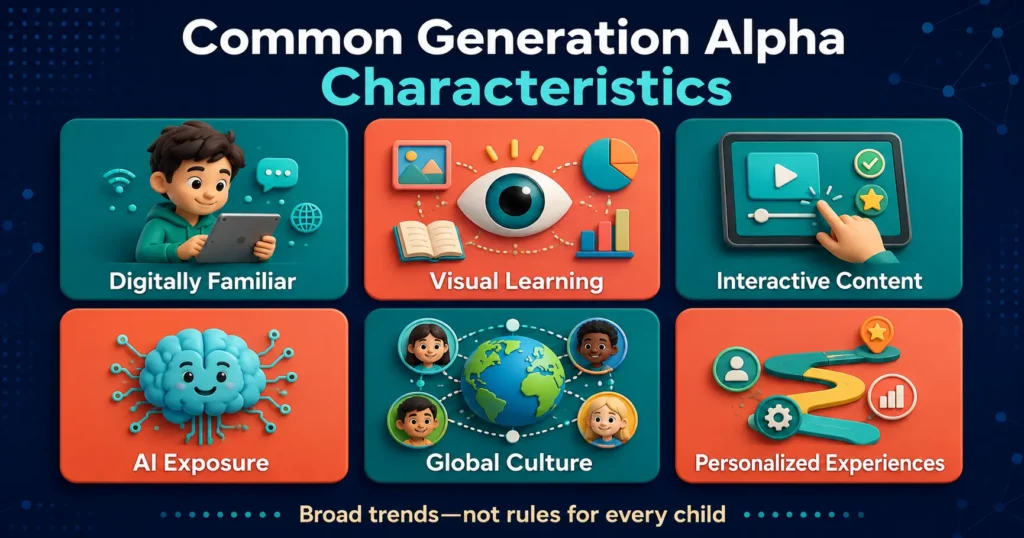
Generation Alpha is often described as technologically confident, visual, globally connected and comfortable with rapid change. These descriptions may be useful when examining broad trends, but they should not become stereotypes.
Possible Generation Alpha characteristics include:
- Early exposure to connected devices
- Familiarity with video-based and interactive content
- Experience with online and blended learning
- Growing exposure to artificial intelligence
- Participation in global digital culture
- Preference for personalized digital experiences
- Need for strong online-safety and media-literacy skills
These are general observations rather than personality rules. Not every Gen Alpha child prefers screens, learns in the same way or has regular internet access.
Parents and teachers should focus on the individual child instead of expecting behaviour based only on a generational label.
Generation Alpha vs Generation Z
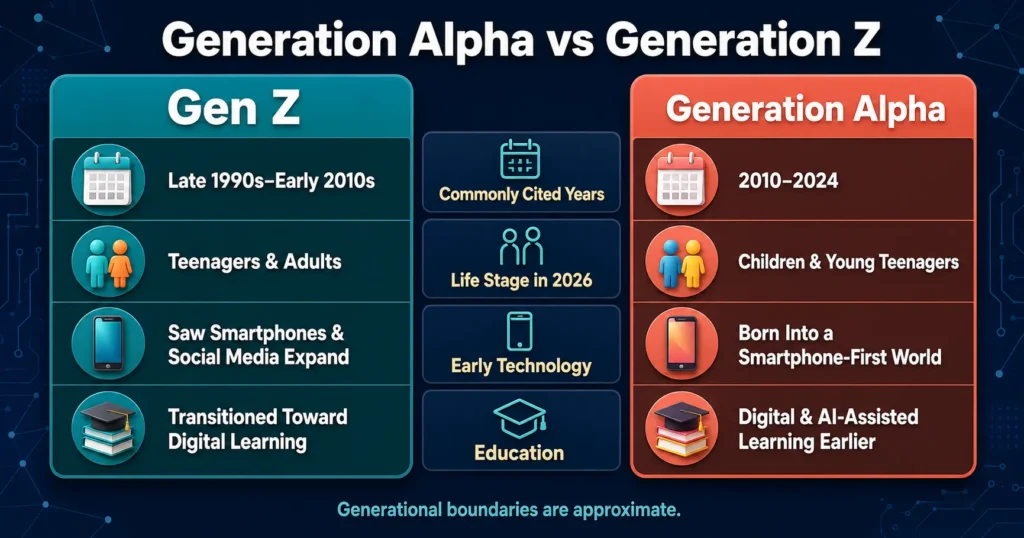
Generation Alpha follows Generation Z, but the boundary between them varies depending on the definition being used.
| Area | Generation Z | Generation Alpha |
| Commonly cited years | Approximately late 1990s to early 2010s | Commonly 2010–2024 |
| Present life stage | Teenagers and adults | Mainly children and young teenagers |
| Early technology environment | Saw smartphones and social media expand | Born after smartphones were already widespread |
| Education | Experienced the transition toward digital learning | More likely to encounter digital and AI-assisted learning early |
| Current independence | Many are studying, working or living independently | Most still depend on parents or guardians |
The two generations also overlap in many ways. Both use digital media, experience online culture and face rapid technological change.
The biggest difference is timing. Gen Z witnessed many modern platforms emerge, while Generation Alpha was generally born into an environment where these technologies already existed.
What Challenges Could Generation Alpha Face?
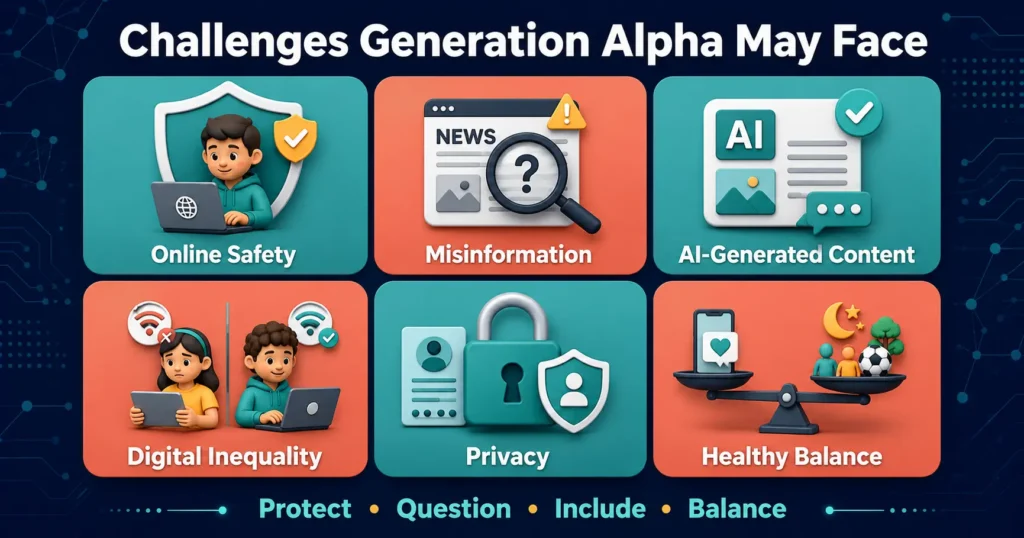
Generation Alpha may benefit from educational technology, medical progress and access to global information. At the same time, its members may face several challenges.
Online safety
Children can encounter inappropriate content, cyberbullying, scams, privacy violations and unwanted contact. Younger users may not recognize manipulation or understand how widely personal information can spread.
Parents should use age-appropriate settings, discuss online experiences regularly and avoid relying only on monitoring software. Children need to feel that they can ask for help without immediately being blamed or punished.
Misinformation and AI-generated content
AI can create realistic images, videos and written material that may be false. Gen Alpha will need strong critical-thinking skills to ask who created something, why it was published and whether trustworthy evidence supports it.
Unequal access to technology
Not every child has reliable internet, updated devices or access to high-quality digital education. As schools use more technology, unequal access may deepen existing educational differences unless governments and institutions address it.
Maintaining balance
Digital tools can support learning and creativity, but children also require sleep, exercise, offline play, family interaction and face-to-face friendships.
A healthy approach considers what a child is doing online, whom they are interacting with and whether technology is replacing important activities. Counting minutes alone does not provide the complete picture.
How Can Parents Support Generation Alpha?
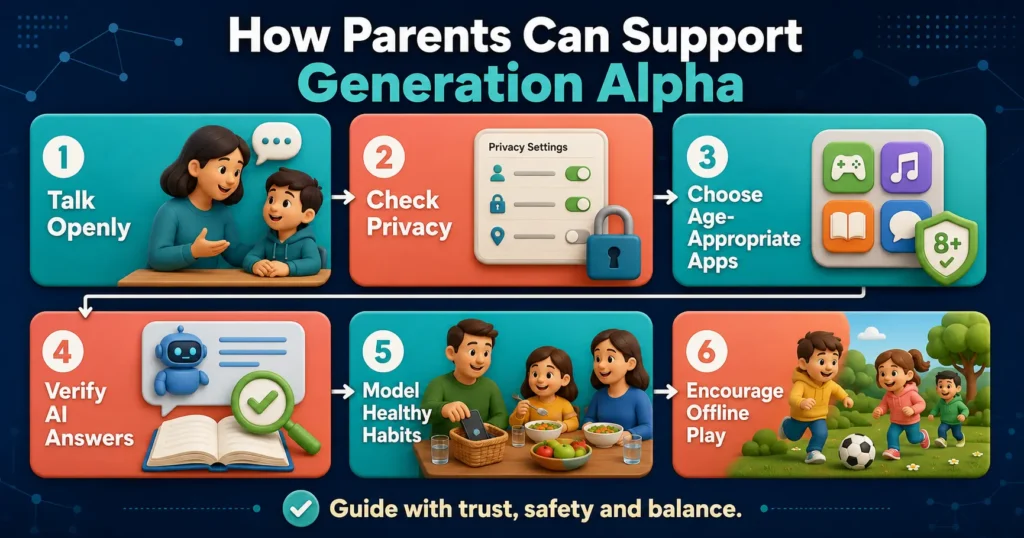
Parents do not need to understand every new application before their children use it. A few consistent habits can make digital family life safer and healthier.
Choose age-appropriate services, review privacy settings and keep younger children’s accounts private. Talk about what children watch and play instead of discussing technology only when something goes wrong.
Parents can also model the habits they expect. For example, family meals can remain device-free, notifications can be silenced during important conversations, and phones can be kept away from sleeping areas.
When children begin using AI, teach them not to share private details and to confirm important answers with reliable sources. Explain that AI can help generate ideas but may also confidently present incorrect information.
Most importantly, make rules according to the child’s age, maturity and needs. A teenager completing schoolwork and a young child watching entertainment do not require identical boundaries.
UNICEF offers dedicated resources on screen habits, privacy, gaming, cyberbullying and parenting in the AI age. UNICEF Digital Parenting
What Will Generation Alpha Be Like in the Future?
It is too early to describe Generation Alpha’s adult identity with certainty. The oldest members are only beginning to enter later adolescence, while the youngest are still very young.
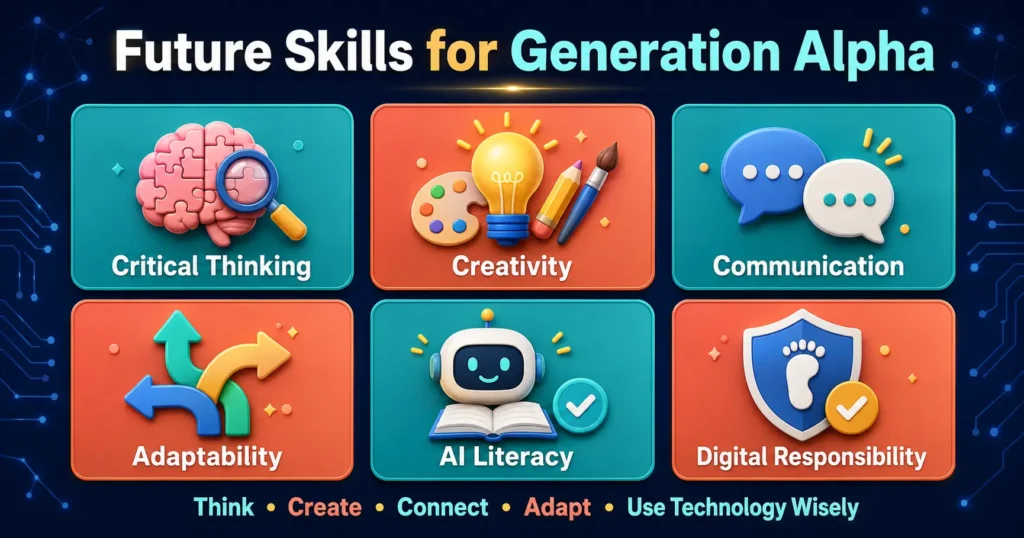
They may enter workplaces influenced by AI, automation, remote collaboration and careers that continue to evolve. Skills such as critical thinking, communication, creativity, adaptability, digital literacy and responsible technology use may become increasingly valuable.
However, the future of Generation Alpha will not be determined by technology alone. Families, schools, communities, economic conditions, public policy and global events will all shape their opportunities.
Predictions should therefore be presented as possibilities—not facts about what every Gen Alpha child will become.
What Comes After Generation Alpha?
The generation following Alpha is commonly called Generation Beta.
Under McCrindle’s classification, Generation Beta includes people born from 2025 to 2039. Because these generational boundaries are not official, the name and dates could be interpreted differently as the cohort grows older.
For now, Generation Alpha remains the youngest generation with a substantial number of children already attending school and participating in digital culture.
Final Thoughts
So, what is Generation Alpha?
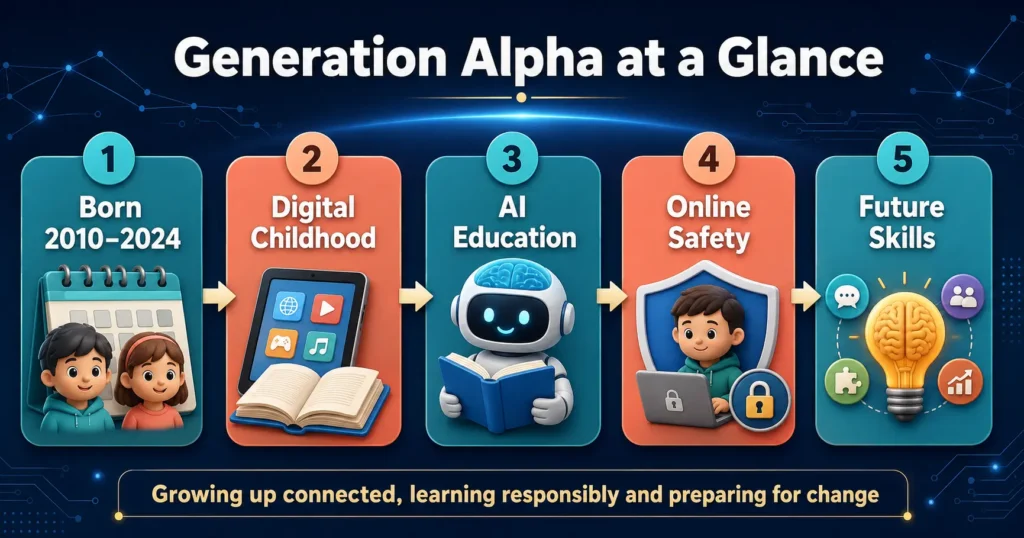
Generation Alpha is the commonly used name for the generation following Gen Z, often defined as people born between 2010 and 2024. Its members are growing up with connected devices, digital education and artificial intelligence as familiar parts of life.
Technology is an important part of their story, but it is not their complete identity. Gen Alpha children live in different countries, cultures and economic conditions. Their experiences cannot be reduced to screens, apps or broad predictions.
For parents and teachers, the most helpful approach is neither to fear technology nor accept it without question. Children need opportunities to learn and create online, along with privacy, protection, critical thinking, offline play and supportive relationships.
As Generation Alpha grows, listening to its members will be more valuable than simply predicting who they will become.
Frequently Asked Questions
What is Generation Alpha in simple words?
Generation Alpha is the generation that comes after Generation Z. It commonly includes children born between 2010 and 2024.
What years are Generation Alpha?
Mark McCrindle defines Generation Alpha as people born from 2010 through 2024. Other sources may use slightly different boundaries because generation dates are not officially fixed.
How old is Generation Alpha in 2026?
Using the 2010–2024 definition, members of Generation Alpha are approximately 1 to 16 years old during 2026, depending on their birth dates.
Why is it called Generation Alpha?
The name begins a new sequence using the Greek alphabet after Generation X, Y and Z. “Alpha” represents a new generational cycle rather than a particular personality type.
Who are the parents of Generation Alpha?
Many Generation Alpha children have Millennial parents. Some also have Generation X or Generation Z parents.
Is a child born in 2012 Gen Z or Gen Alpha?
It depends on the generational definition being followed. Under McCrindle’s commonly cited 2010–2024 range, a child born in 2012 belongs to Generation Alpha. Other definitions may place 2012 near the boundary between Gen Z and Gen Alpha.
Is Generation Alpha addicted to technology?
It is inaccurate to describe an entire generation as addicted to technology. Many Gen Alpha children use connected devices regularly, but usage and behaviour vary considerably. Parents concerned about an individual child should consider whether device use is interfering with sleep, school, physical activity or relationships.
What generation comes after Gen Alpha?
Generation Beta is the proposed name for the generation following Alpha. One widely cited definition places Generation Beta from 2025 to 2039.
What is the main difference between Gen Z and Gen Alpha?
Gen Z experienced the expansion of smartphones and social media during childhood or adolescence. Most Gen Alpha children were born after these technologies had already become widely established.
What skills will Generation Alpha need?
Likely valuable skills include critical thinking, communication, creativity, adaptability, digital literacy, online safety and responsible AI use. However, future education and employment needs will continue to change.
Editorial Note
Generational boundaries are debated and should be treated as approximate social categories. This article uses the 2010–2024 definition published by McCrindle Research and clearly identifies predictions as possibilities. Child-safety information is informed by UNICEF resources.
2 Comments