ChatGPT can explain difficult concepts, create practice questions, provide feedback and help students organize their ideas. However, it can also produce incorrect answers, invent sources and make it easy for children to submit work they did not create or understand.
So, should children use ChatGPT for homework?
Children who meet ChatGPT’s age requirements may use it for homework when their school permits it and when the tool supports—not replaces—their thinking. Younger teenagers need parental permission, and children under the minimum age should not create or use their own ChatGPT accounts.
The most helpful approach is to use ChatGPT like a tutor. A child can ask for an explanation, request a hint, practise a skill or receive feedback on work already attempted.
It should not be used as an invisible answer machine that completes an assignment for the student to submit unchanged.
Parents and teachers should establish clear rules, protect children’s privacy and teach students to verify every important claim.
What Is ChatGPT?
ChatGPT is an artificial intelligence assistant developed by OpenAI. It can respond to questions and create content in a conversational format.
Students may use it to:
- Explain concepts
- Work through problems
- Create practice questions
- Summarize notes
- Brainstorm ideas
- Review writing
- Practise languages
- Prepare for examinations
- Explore different viewpoints
- Organize a study plan
ChatGPT generates responses based on patterns learned from data and the instructions provided by the user. It does not understand a student in exactly the same way as a human teacher, and its answers are not guaranteed to be correct.
A clear and detailed answer can still contain a factual, mathematical or reasoning error.
What Is the Minimum Age for ChatGPT?
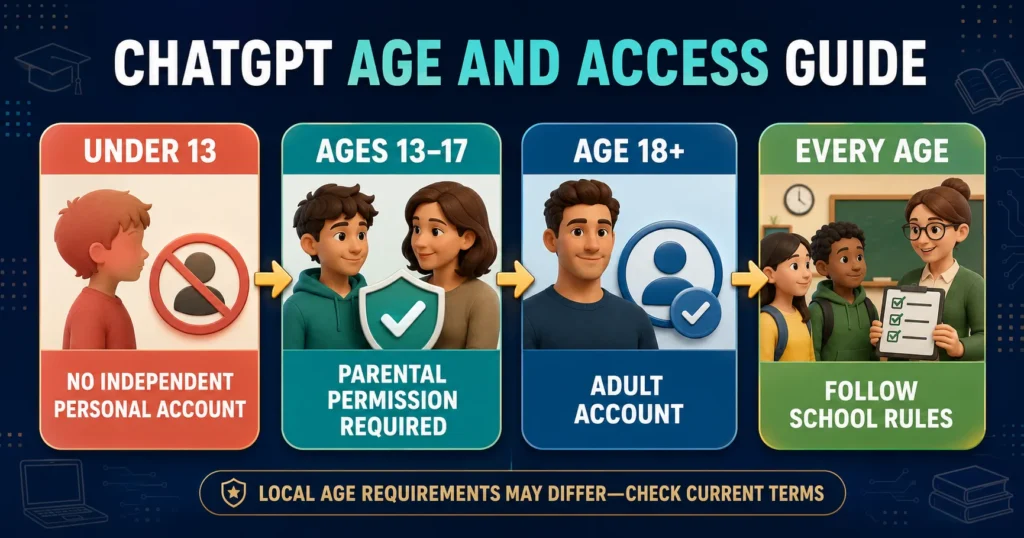
According to OpenAI’s current terms, users must be at least 13 years old—or the minimum age required in their country—to consent to using the service.
Users under 18 must have permission from a parent or legal guardian.
Therefore:
- Children under 13 should not create or independently use a personal ChatGPT account.
- Teenagers aged 13–17 need permission from a parent or legal guardian.
- Local age requirements may be higher in some countries.
- Schools may provide access through separately managed educational arrangements.
- Parents should confirm the current terms because product requirements can change.
Meeting the minimum age does not automatically mean that unsupervised use is appropriate for every teenager. Parents should also consider maturity, privacy awareness and the child’s ability to question AI-generated information.
Is ChatGPT Designed to Help With Homework?
ChatGPT can be used as a learning aid, and OpenAI provides Study Mode, which is intended for tasks such as homework assistance, test preparation and learning new subjects.
Rather than immediately giving a complete answer, Study Mode can ask questions, guide the learner through a problem and adjust explanations based on the conversation.
However, OpenAI also states that Study Mode can behave inconsistently and make mistakes. It remains an AI system rather than a guaranteed source of correct educational guidance. OpenAI: Introducing Study Mode
The existence of a study feature does not mean every school permits ChatGPT for every assignment. Students must still follow their teacher’s instructions.
Also, check our guide on How to Keep Children Safe Online: A Practical Parent Guide
When Can ChatGPT Help a Student Learn?
ChatGPT is most useful when it helps the student complete the thinking rather than completing the assignment for them.
1. Explaining Difficult Concepts
A student can ask ChatGPT to explain a topic using simpler language or a familiar example.
For example:
“Explain photosynthesis in simple English for a 12-year-old. Then ask me three questions to check my understanding.”
The student should compare the explanation with class notes, textbooks or reliable educational sources.
2. Providing Hints
Instead of requesting the final answer, a student can ask for the next step.
For example:
“I am solving this equation. Do not give me the final answer. Give me one hint about what I should do next.”
This approach preserves the student’s mental effort.
3. Creating Practice Questions
ChatGPT can turn notes into practice activities.
A student might ask:
“Create ten questions from these notes. Ask them one at a time, wait for my answer and explain any mistake.”
Students should check that the generated questions accurately reflect their course material.
4. Reviewing a Student’s Own Work
A child can complete a first draft and then request feedback.
For example:
“Here is my paragraph. Identify two areas that are unclear, but do not rewrite it for me.”
This allows the student to revise independently instead of replacing their writing with AI-generated text.
5. Practising a Language
ChatGPT can simulate simple conversations, explain grammar and offer vocabulary exercises.
A student can request:
“Have a beginner-level conversation with me in French. Correct my mistakes after each response and explain the correction in English.”
AI language feedback can still contain errors, so important work should be checked by a teacher or reliable language source.
6. Comparing Viewpoints
For a topic with multiple perspectives, students can ask ChatGPT to outline different arguments.
The student should then locate reliable sources representing those viewpoints rather than citing the AI response itself.
7. Creating a Study Plan
Students can use ChatGPT to divide a large syllabus into smaller revision sessions.
They should provide:
- The examination date
- Available study time
- Topics to cover
- Areas they find difficult
- Existing responsibilities
The student and parent should review whether the resulting schedule is realistic.
8. Supporting Accessibility
Some students may benefit from:
- Simplified explanations
- Text restructuring
- Vocabulary support
- Alternative examples
- Step-by-step instructions
- Translation assistance
AI should complement appropriate educational and accessibility support rather than replacing qualified teachers or specialists.
When Does ChatGPT Harm Learning?
ChatGPT may weaken learning when a student uses it to avoid the exact thinking an assignment is designed to develop.
Copying Complete Answers
If a student asks ChatGPT to write an essay and submits it unchanged, the finished paper does not show the student’s own understanding or writing ability.
Even if the information is accurate, the student may miss opportunities to practise:
- Research
- Reasoning
- Planning
- Writing
- Revision
- Problem-solving
- Source evaluation
The student may also violate school academic-integrity rules.
Requesting Only Final Answers
Receiving a final mathematical answer can help complete a worksheet, but it may not teach the student how the solution works.
A better request is:
“Show me the first step and ask what I think should happen next.”
Depending on AI for Every Difficulty
Learning often involves confusion, effort and correction.
If children immediately ask AI whenever a task feels difficult, they may have fewer opportunities to develop persistence and independent problem-solving.
Parents can encourage students to try first, identify the exact point of confusion and then use ChatGPT for targeted help.
Trusting AI Without Checking
ChatGPT may produce an incorrect response in a polished style. Students who assume fluency means accuracy may learn false information.
The risk is greater when the topic is:
- Highly specialized
- Recently changed
- Locally specific
- Based on exact quotations
- Dependent on current laws or policies
- Medical, legal or financial
- Supported by academic citations
Using AI Secretly
Secret use makes it difficult for teachers to assess learning and provide suitable guidance.
If a student believes AI use is necessary, they should first ask whether the teacher permits it and how assistance should be disclosed.
Can ChatGPT Give Wrong Homework Answers?
Yes.
ChatGPT can:
- Make calculation errors
- Misread a question
- Invent a quotation
- Attribute information to the wrong person
- Produce a source that does not exist
- Use outdated information
- Oversimplify a complex topic
- Provide an answer inconsistent with the student’s curriculum
- Repeat bias present in available information
- Sound confident despite uncertainty
Students should never assume that a response is correct merely because it is detailed.
How Should Students Check ChatGPT Answers?
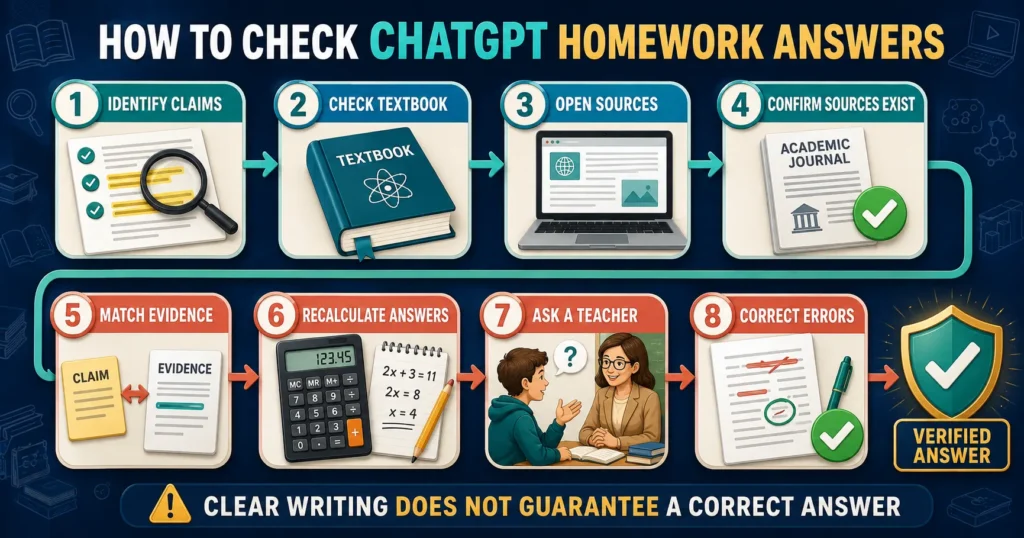
Use a simple verification process:
- Identify the factual claims.
- Compare them with the textbook or class notes.
- Open any cited sources.
- Confirm that each source exists.
- Check whether the source actually supports the claim.
- Recalculate mathematical answers independently.
- Ask a teacher when information conflicts.
- Correct the response before using it for learning.
Students should not cite ChatGPT as though it were the original source of a historical date, scientific finding or quotation. They should locate and cite the actual source.
Can ChatGPT Invent Sources?
Yes. Generative AI can create references that look realistic but do not exist.
A fabricated reference may include:
- A believable author name
- A realistic journal title
- A false article title
- An invented page number
- An incorrect website address
- A real source attached to an unrelated claim
Students should open every source and confirm its details through a trusted database, library catalogue or original publication.
If a source cannot be found, it should not be included in the assignment.
Is Using ChatGPT for Homework Cheating?
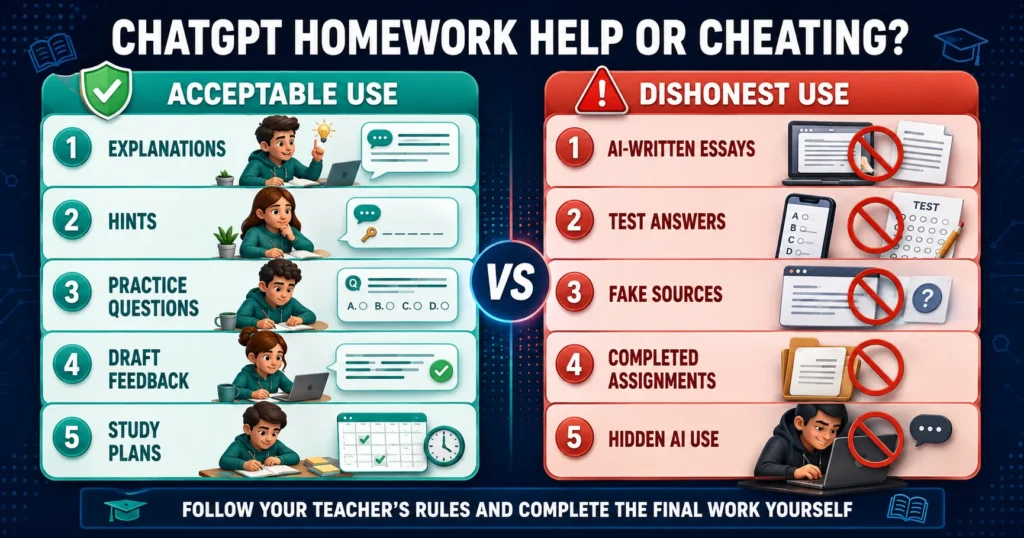
Using ChatGPT is not automatically cheating. It depends on:
- The teacher’s instructions
- The school’s policy
- The purpose of the assignment
- How the tool was used
- Whether the use was disclosed
- How much of the final work belongs to the student
Usually acceptable when permitted
- Asking for a simpler explanation
- Requesting practice questions
- Receiving feedback on a draft
- Brainstorming possible topics
- Checking grammar while preserving the student’s ideas
- Requesting hints
- Creating a revision plan
Potentially dishonest or prohibited
- Submitting an AI-written essay as original work
- Using ChatGPT during a closed assessment
- Generating fake references
- Asking AI to complete graded problem sets
- Hiding required disclosure
- Rewriting copied material to avoid plagiarism detection
- Uploading another student’s work
- Ignoring an explicit teacher ban
When uncertain, the student should ask the teacher before using the tool.
Should Students Disclose ChatGPT Use?
If a teacher or school requires disclosure, students must explain how they used ChatGPT.
Even when no formal rule exists, disclosure may be appropriate when AI materially influences the work.
A simple statement might say:
“I used ChatGPT to generate practice questions and to provide feedback on the organization of my first draft. I checked the factual information against the assigned textbook and wrote the final response myself.”
The exact format should follow the teacher’s instructions.
Students should preserve useful records such as prompts, drafts and revision notes if a teacher requests evidence of their process.
How Can Children Use ChatGPT Responsibly?
A practical rule is:
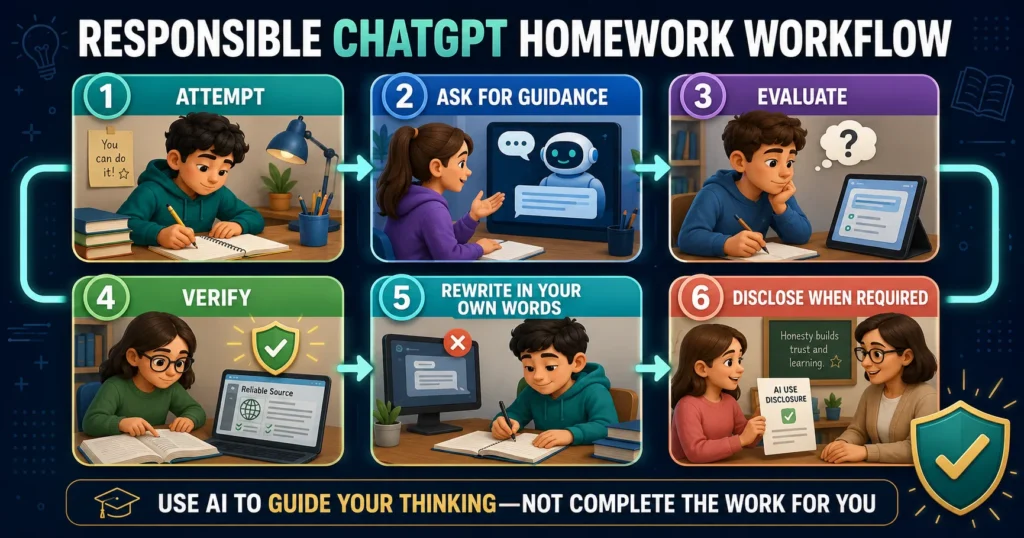
Try first, ask for guidance, verify the response and complete the final work yourself.
Step 1: Read the Assignment
The student should understand:
- What the teacher is assessing
- Whether AI is permitted
- Which sources are required
- Whether assistance must be disclosed
- What must be completed independently
Step 2: Attempt the Work First
The child should write initial ideas, solve the first steps or identify the area of confusion.
This gives ChatGPT something specific to help with and protects independent learning.
Step 3: Ask for Guidance, Not Replacement
Good requests include:
- “Explain this concept another way.”
- “Give me one hint.”
- “Ask me questions that help me find the answer.”
- “Point out where my reasoning becomes unclear.”
- “Create a similar problem for practice.”
- “Check my method without rewriting my answer.”
Step 4: Verify the Response
Use textbooks, teachers and reliable sources.
For mathematics, complete the calculation independently. For essays, open all citations. For science, compare explanations with trusted educational material.
Step 5: Rewrite in the Student’s Own Understanding
Students should close the AI response and explain the idea independently.
If they cannot explain it without looking at ChatGPT, they may not yet understand it.
Step 6: Disclose Use When Required
Follow the relevant school policy and never misrepresent AI-generated work as entirely original.
The Green, Yellow and Red Approach
Parents and teachers can use a simple colour system.
| Level | Example uses |
|---|---|
| Green | Explanations, hints, practice questions, flashcards and feedback |
| Yellow | Brainstorming, outlining, summarizing and grammar assistance that require close review |
| Red | Complete graded answers, tests, fake citations, impersonation and hidden AI-written submissions |
The category may change according to the assignment. For example, outlining may be acceptable in one class but prohibited when the teacher is specifically assessing outlining skills.
Good ChatGPT Prompts for Homework
For understanding a concept
“Explain [topic] in simple English for a student in grade [level]. Use one everyday example, then ask me to explain it back to you.”
For mathematics
“Do not give me the final answer. Look at my working, identify my first mistake and give me one hint.”
For revision
“Use these notes to quiz me. Ask one question at a time and explain why my answer is correct or incorrect.”
For essay planning
“Ask me five questions that will help me develop my own argument about [topic]. Do not write the essay.”
For feedback
“Read my draft and identify unclear reasoning, missing evidence and grammar patterns. Do not rewrite the paragraph.”
For source checking
“List the factual claims in this answer that I should verify. Do not invent sources. Clearly state when you are uncertain.”
For studying from notes
“Use only the notes I provide. If the answer is not present, tell me instead of adding outside information.”
Poor Prompts Students Should Avoid
- “Write my complete essay.”
- “Give me the answers to this test.”
- “Make this impossible for my teacher to detect.”
- “Invent five academic sources.”
- “Rewrite this copied paragraph so it is not plagiarism.”
- “Complete my homework and make it look like a student wrote it.”
- “Give me only the final answer.”
- “Pretend I did not use AI.”
These prompts prioritize finishing the task over learning and may violate academic-integrity rules.
ChatGPT Study Mode for Homework
OpenAI’s Study Mode is designed to guide learning through questions and step-by-step interaction.
It can be useful for:
- Working through homework problems
- Preparing for tests
- Understanding new topics
- Checking knowledge
- Exploring concepts at an appropriate level
Students can activate it by selecting Study and learn from the available tools in ChatGPT, where offered.
Study Mode is not perfect. OpenAI notes that it may show inconsistent behaviour or make mistakes. Students must still verify information and follow school rules.
A student can also give Study Mode more useful context:
“I am in grade eight and learning linear equations. My teacher wants us to solve by balancing both sides. Ask me questions instead of giving the final answer.”
Do not upload confidential school material unless the teacher and school permit it.
Privacy Rules for Students
Children should not enter sensitive personal information into ChatGPT.
Avoid sharing:
- Full home address
- Phone number
- Passwords
- Identification documents
- Live location
- Private photographs
- Medical records
- Family financial details
- Confidential school records
- Another student’s personal information
- Teacher information that is not public
- Unpublished research or protected assessment materials
Before uploading an assignment, check whether it contains the student’s full name, school, student number or other identifiers. Remove unnecessary personal information.
Students should also follow their school’s rules about uploading class materials, textbooks, examination papers and other copyrighted or confidential documents.
How Can Parents Supervise ChatGPT Use?
Parents do not need to sit beside a teenager during every study session, but they should establish clear expectations.
Ask the child to show:
- What they asked ChatGPT
- What response they received
- How they checked it
- What they changed
- What they learned
- Whether the teacher permits AI
- How the final submission represents their own work
A useful parent rule might be:
“You may use ChatGPT for explanations, hints and practice when your teacher permits it. You may not submit a response you do not understand or claim AI-generated work as entirely your own.”
Parents should periodically review current age requirements, privacy settings and product changes through official OpenAI information.
How Can Teachers Set Clear ChatGPT Rules?
Teachers can reduce confusion by stating what is allowed for each assignment.
An assignment might use one of these approaches:
No AI use
The student completes all work independently because the teacher is assessing unaided knowledge or skill.
Limited AI use
The student may use ChatGPT for brainstorming, explanations or grammar feedback but not for generating final content.
AI-supported assignment
Students intentionally use ChatGPT, evaluate its response and document their prompts and corrections.
Open AI use with disclosure
Students may use AI broadly but must remain responsible for accuracy, citations and an explanation of their process.
Clear rules are more helpful than assuming students know where the boundary lies.
Can AI Detectors Prove That a Student Used ChatGPT?
AI-detection software should not be treated as unquestionable proof.
Detection tools may incorrectly label human writing as AI-generated or fail to identify AI-generated work. Text can also be edited in ways that affect detector results.
Teachers should consider multiple forms of evidence, such as:
- The student’s previous work
- Draft history
- Notes
- Sources
- In-class writing
- Oral explanation
- Revision decisions
- The student’s understanding of the submitted work
Students should not attempt to “humanize” AI-generated text merely to bypass detection. The correct approach is to produce authentic work and disclose assistance when required.
Benefits of Using ChatGPT for Homework
When used responsibly, ChatGPT may help students:
- Receive explanations at any time
- Ask questions without embarrassment
- Practise at their own pace
- Explore different explanations
- Generate quizzes and examples
- Improve study organization
- Receive preliminary feedback
- Develop AI literacy
- Practise languages
- Build confidence before asking a teacher
These benefits are strongest when the student remains mentally active.
Risks of Using ChatGPT for Homework
Possible risks include:
- Incorrect answers
- Fabricated sources
- Academic dishonesty
- Reduced independent thinking
- Overdependence
- Privacy concerns
- Biased or incomplete information
- Inappropriate responses
- Differences from the school curriculum
- Unequal access among students
- Confusion about authorship
- Loss of important practice
The goal is not to deny these risks or exaggerate them. It is to establish safeguards appropriate to the student and assignment.
ChatGPT vs a Human Teacher
ChatGPT can provide quick explanations, but it cannot fully replace a teacher.
| ChatGPT | Human teacher |
| Available quickly | Understands the classroom context |
| Can provide repeated explanations | Observes the student over time |
| Can generate practice questions | Uses professional judgment |
| May confidently provide false information | Can align help with the curriculum |
| Does not truly know the child | Builds a real educational relationship |
| Cannot carry safeguarding responsibility | Can respond through established support systems |
Students should approach teachers when:
- Instructions are unclear
- The AI answer conflicts with the course
- They remain confused
- The issue affects grades
- They need personal learning support
- The topic involves safety or well-being
Should Primary-School Children Use ChatGPT?
Children below ChatGPT’s minimum age should not operate their own accounts.
A parent or teacher may sometimes demonstrate AI in an adult-managed, age-appropriate educational activity, subject to school rules and current product terms. The adult should control the interaction, avoid entering children’s personal information and verify the output.
For younger children, direct teaching, books, play and conversation should remain central.
Should Teenagers Use ChatGPT for Homework?
Teenagers who meet the minimum age requirement, have parental permission and follow school rules may benefit from ChatGPT.
They should be able to understand that:
- ChatGPT is not always accurate
- Personal information requires protection
- Sources must be verified
- AI assistance may require disclosure
- Submitted work remains their responsibility
- ChatGPT should not replace teachers or independent effort
Access should expand according to the teenager’s demonstrated responsibility, not age alone.
When Should ChatGPT Not Be Used?
Children should avoid using ChatGPT:
- During tests where AI is prohibited
- To complete work required to be independent
- To generate false citations
- To hide plagiarism
- To process confidential student information
- As a substitute for emergency help
- For important medical, legal or financial decisions
- To impersonate another person
- To create harmful or humiliating content
- When the child does not meet the service’s age requirements
A Parent’s ChatGPT Homework Checklist
Before allowing ChatGPT for an assignment, ask:
- Does my child meet the minimum age?
- Have I given informed permission where required?
- Does the teacher allow AI for this task?
- Does my child understand the assignment?
- Has the child attempted it first?
- Is ChatGPT providing guidance rather than replacement?
- Has private information been removed?
- Will factual claims and citations be verified?
- Can the child explain the final answer?
- Will AI assistance be disclosed if required?
If several answers are no, the student should pause and ask a parent or teacher for guidance.
Final Verdict: Should Children Use ChatGPT for Homework?
ChatGPT can support homework when it acts as a tutor, practice partner or feedback tool. It should not become a substitute for effort, teaching or independent thought.
Children should use ChatGPT only when:
- They meet the service’s age requirements
- A parent or guardian has provided permission when required
- Their school or teacher allows it
- They protect personal information
- They verify important answers
- They remain responsible for the final work
- They disclose AI assistance when required
The best pattern is:
Attempt → Ask → Evaluate → Verify → Rewrite → Disclose
A child who copies an AI-generated answer may finish homework more quickly but learn less. A child who asks for a hint, questions the response and explains the solution independently can use the same technology to strengthen learning.
The question is therefore not simply whether children should use ChatGPT. It is whether they are using it in a way that develops—or replaces—the skills the homework was designed to teach.
Frequently Asked Questions
Is ChatGPT good for homework?
ChatGPT can be useful for explanations, hints, practice questions and feedback. It is less helpful when it completes the assignment and removes the student’s need to think.
What age can children use ChatGPT?
OpenAI’s terms require users to be at least 13, or the minimum age required in their country. Users under 18 need permission from a parent or legal guardian.
Can a 10-year-old use ChatGPT?
A ten-year-old should not create or independently use a personal ChatGPT account under the general minimum-age requirement. A parent or teacher may demonstrate AI through an adult-managed educational activity where permitted.
Can a 13-year-old use ChatGPT?
A 13-year-old may meet the general minimum age, depending on local requirements, but still needs permission from a parent or legal guardian and must follow school rules.
Is using ChatGPT for homework cheating?
It depends on the assignment and school policy. Explanations or practice may be allowed, while submitting AI-generated work as original may be considered academic dishonesty.
Can ChatGPT solve mathematics homework?
It can explain methods and work through problems, but it may make mistakes. Students should verify each step and use it for guidance rather than copying only the final answer.
Can ChatGPT write a student’s essay?
It can generate text, but submitting an AI-written essay as the student’s own may violate academic-integrity rules and prevent the student from developing writing skills.
Should students cite ChatGPT?
Students should follow their institution’s rules for disclosing or citing AI use. Factual claims should be supported by original, reliable sources rather than ChatGPT alone.
Can ChatGPT create fake references?
Yes. ChatGPT can generate citations that appear genuine but do not exist. Every reference must be opened and verified before use.
What is ChatGPT Study Mode?
Study Mode is a learning-focused ChatGPT feature intended to guide users through questions and explanations. It can help with homework and test preparation but may still make mistakes.
What should students never share with ChatGPT?
Students should not share passwords, addresses, identification documents, private images, confidential records or another person’s personal information.
Can ChatGPT replace a tutor or teacher?
No. It can provide additional explanations and practice, but it cannot replace a qualified teacher’s judgment, curriculum knowledge, relationship and safeguarding role.
Editorial Note
ChatGPT features, age requirements and school policies may change. This article reflects information available in August 2026. Families should review OpenAI’s current terms and their school’s AI policy before a child uses ChatGPT.
This article provides general educational information and is not affiliated with, sponsored by or endorsed by OpenAI.
Last reviewed: August 2026
Author: [Add the writer’s real name and relevant biography]
Reviewed by: [Add a qualified educator, academic-integrity specialist or child online-safety professional only if that person genuinely reviews the article]