
Generation Alpha is no longer simply a generation to watch. Its oldest members are teenagers, its youngest members are toddlers, and its influence is already visible in American homes, classrooms, media habits and household spending.
This guide brings together the latest reliable Generation Alpha statistics for the United States available as of August 2026. The figures come from the U.S. Census Bureau, the National Center for Education Statistics, PwC, Pew Research Center and Common Sense Media. Because government agencies do not officially classify Americans as “Generation Alpha,” every statistic below includes the age group, survey date and source needed to interpret it correctly.
If you are new to the subject, begin with our explanation of what Generation Alpha is, including its years, defining experiences and likely future.
Generation Alpha Statistics 2026: Quick Facts
| Statistic | Population covered | Source |
|---|---|---|
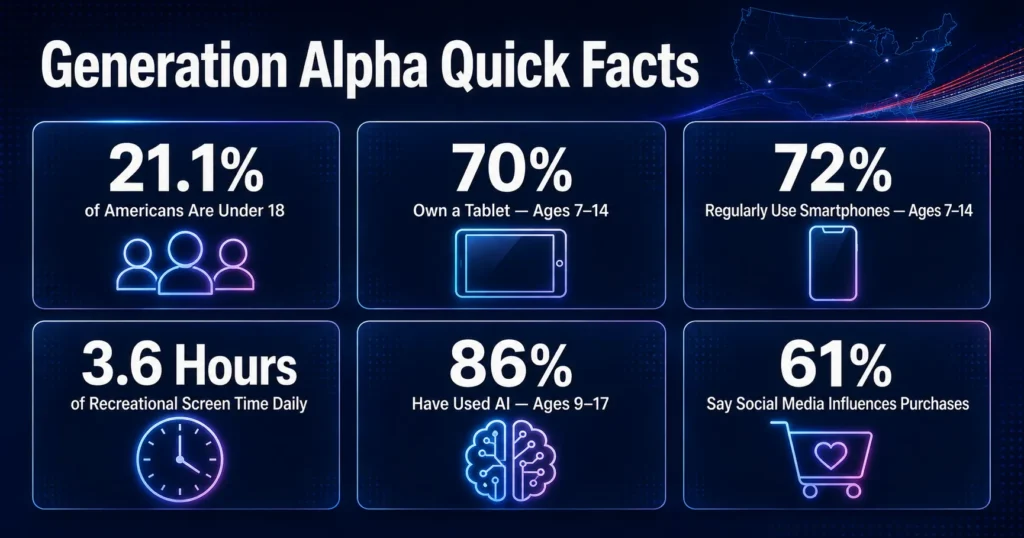
| People under age 18 represent 21.1% of the U.S. population | U.S. residents, July 2025 estimate | U.S. Census Bureau |
| The oldest members of Gen Alpha turn 16 in 2026 | People born in 2010, using the 2010–2024 definition | McCrindle definition |
| 70% own a tablet and 72% regularly use a smartphone | U.S. children ages 7–14 | PwC, 2026 |
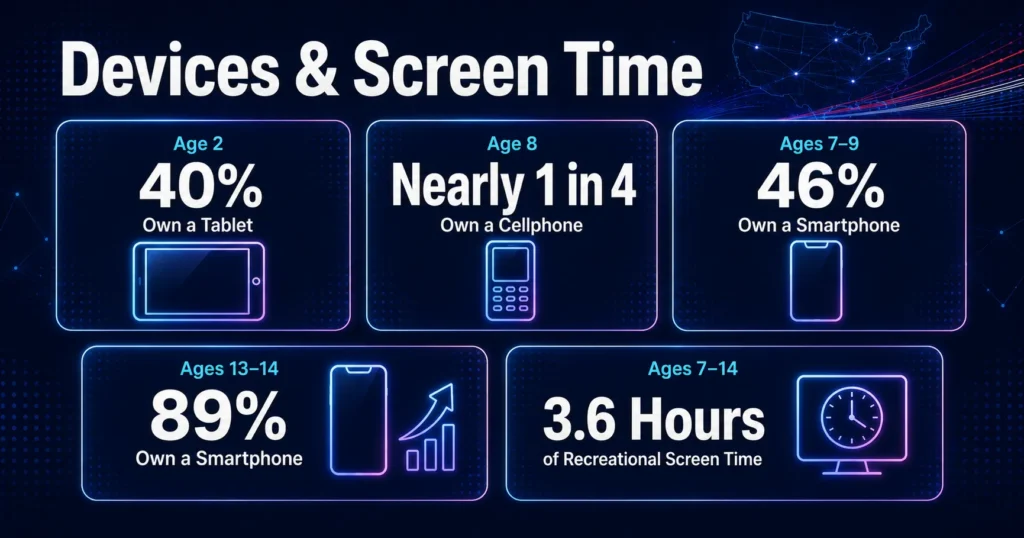
| Smartphone ownership rises from 46% at ages 7–9 to 89% at ages 13–14 | U.S. children ages 7–14 | PwC, 2026 |
| Recreational screen use averages 3.6 hours per day | U.S. children ages 7–14 | PwC, 2026 |
| Screen-media use averages about 2.5 hours per day | U.S. children ages 0–8 | Common Sense Media, 2025 |
| 40% have their own tablet by age 2 | U.S. children | Common Sense Media, 2025 |
| Nearly one-quarter have a personal cellphone by age 8 | U.S. children | Common Sense Media, 2025 |
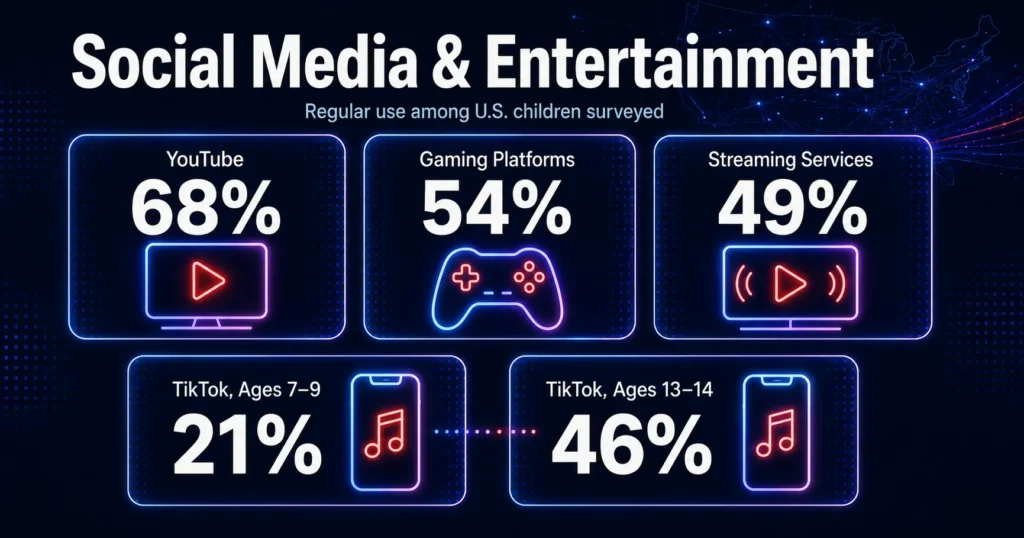
| 68% regularly use YouTube and 54% use gaming platforms | U.S. children ages 7–14 | PwC, 2026 |
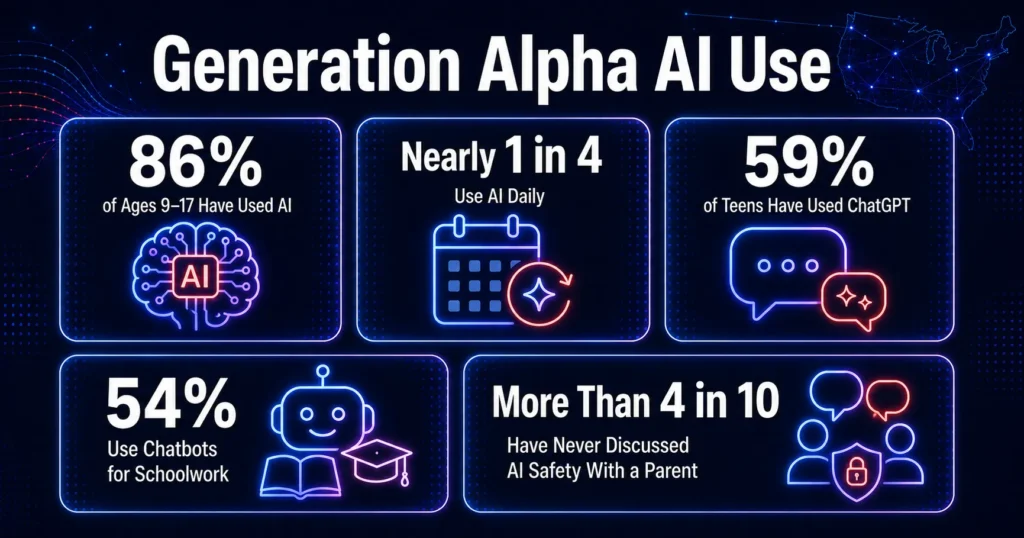
| 86% have used some form of AI and nearly one-quarter use it daily | U.S. children ages 9–17 | Common Sense Media, 2026 |
| 64% have used an AI chatbot and 59% have used ChatGPT | U.S. teens ages 13–17 | Pew Research Center, 2025 |
| 61% say social media makes them want to buy products | U.S. children ages 7–14 | PwC, 2026 |
| 97% say they make at least some buying decisions independently | U.S. children ages 7–14 | PwC, 2026 |
These numbers come from different studies and should not be merged into a single average. A statistic about 7- to 14-year-olds, for example, cannot automatically describe a toddler or every American teenager.
Who Counts as Generation Alpha in 2026?
There is no legally or scientifically fixed birth range for a generation. In this article, Generation Alpha refers to people born from 2010 through 2024, the 15-year range used by social researcher Mark McCrindle, who introduced the name. Under this definition, members of Gen Alpha are approximately 2 to 16 years old in 2026. McCrindle explains the 2010–2024 range here.
Other researchers and publishers may end the cohort in 2025 or use a slightly different starting year. That variation explains why some studies include ages that overlap with late Gen Z or early Generation Beta. When comparing Gen Alpha data, the stated ages are usually more dependable than the generation label.
How Large Is Generation Alpha in the United States?
There is no official federal count of Generation Alpha because the U.S. Census Bureau reports population by age rather than marketing-generation labels. Census QuickFacts estimated the total U.S. population at 341,784,857 on July 1, 2025, with people under 18 accounting for 21.1% of the population.
That under-18 percentage gives useful context, but it is not an exact Gen Alpha total. It includes 17-year-olds who fall outside the 2010–2024 definition, while babies born in 2025 and 2026 belong to Generation Beta under the same framework. Any website claiming an exact current U.S. Gen Alpha population should therefore explain its birth-year range and calculation method.
The geographic pattern is also changing. Census estimates released in 2026 found that the South was the only U.S. region where the under-18 population grew between 2020 and 2025. It increased by 1.1%, while the under-18 population declined in the Northeast, Midwest and West.
Generation Alpha Is a Highly Diverse U.S. Cohort
The youngest Americans are more racially and ethnically diverse than the adult population. Using 2020 Census data, the Census Bureau calculated a Diversity Index of 68.5% for people under 18, compared with 58.3% for adults. The index represents the probability that two randomly selected people belong to different racial or ethnic groups.
Public-school enrollment shows the same broad pattern. In fall 2023, U.S. public-school students were 43.7% White, 29.5% Hispanic, 14.9% Black, 5.6% Asian, 5.1% two or more races, 0.9% American Indian or Alaska Native and 0.4% Pacific Islander, according to the National Center for Education Statistics.
These figures do not mean every Gen Alpha community looks the same. Family income, disability, language, location and access to technology can produce very different childhood experiences within the same generation.
Smartphones, Tablets and Screen Time
Screens are present early in American childhood, but device ownership changes sharply with age.
PwC’s 2026 U.S. survey of more than 1,000 children ages 7–14 and 1,000 parents found that 70% of children owned a tablet and 72% regularly used smartphones. Smartphone ownership rose from 46% among 7- to 9-year-olds to 89% among 13- to 14-year-olds.
PwC also found that children ages 7–14 spent an average of 3.6 hours per day using screens for recreation. This number excludes at least some school-related use, which is important when comparing it with broader measures of daily screen exposure.
For younger children, the 2025 Common Sense Census reported average screen-media use of about 2.5 hours per day among children ages 0–8. It also found that 40% had their own tablet by age 2, while nearly one-quarter had a personal cellphone by age 8. Gaming time among this age group increased 65% over four years, even though total daily screen time remained broadly stable.
The two studies use different age groups and methods, so the 2.5-hour and 3.6-hour figures should not be treated as a single trend line. They do, however, show how digital access expands as children move from early childhood into the tween and young-teen years.
Screen time alone also does not reveal whether a child was video-calling family, creating art, completing schoolwork or endlessly scrolling. Parents need to consider content, context, sleep, movement and the child’s individual needs. Our guide to keeping children safe online offers practical steps for privacy, parental controls and family conversations.
YouTube, Gaming, Streaming and Social Media
Video and gaming are central to Gen Alpha’s entertainment environment. PwC found that 68% of U.S. children ages 7–14 regularly used YouTube, 54% used gaming platforms and 49% used streaming services.
Platform use changes considerably within the generation. TikTok was regularly used by 21% of children ages 7–9 in PwC’s survey, rising to 46% among ages 13–14. That age gap is a reminder that a single “Gen Alpha social-media statistic” can hide major developmental differences.
Pew Research Center’s 2025 teen survey provides additional context for the oldest members of the cohort, although its 13–17 sample also includes some late Gen Z respondents. Pew found that 97% of U.S. teens used the internet daily. Thirty-six percent used at least one of five major platforms almost constantly, while roughly one in five described their TikTok or YouTube use that way.
The available evidence shows widespread access, not a single effect. Social platforms can support creativity, entertainment and connection, but outcomes depend on the platform, content, design, time spent and the child using it.
Artificial Intelligence Use Among Gen Alpha
AI has moved rapidly from novelty to an everyday childhood tool.
The 2026 Common Sense Media Census surveyed 1,204 U.S. children ages 9–17. It found that 86% had used AI and nearly one-quarter used it every day. More than four in ten said a parent or guardian had never spoken with them about AI safety. Only about one-third understood that AI cannot reliably separate fact from fiction.
Age-specific results show how quickly academic use is developing. Among young people who used AI, 39% of 9- to 12-year-olds used it for schoolwork at least weekly, including 12% who did so daily. Weekly schoolwork use rose to 50% among ages 13–15, including 24% who used it daily.
Pew Research Center’s December 2025 report reached a similar conclusion in its nationally representative survey of 1,458 U.S. teens ages 13–17. Sixty-four percent reported using an AI chatbot, 59% had used ChatGPT and roughly three in ten used chatbots daily. A February 2026 follow-up analysis found that more than half had used chatbots to search for information (57%) or get help with schoolwork (54%), while 47% had used them for entertainment.
AI use can also become personal. Pew found that 16% of teens had used chatbots for casual conversation and 12% had sought emotional support or advice. These figures do not prove that every use was harmful, but they show why families and schools need discussions about privacy, inaccurate answers, emotional dependence and when to consult a trusted adult.
For schoolwork, the central issue is not simply whether students use AI. It is whether they verify information, follow school rules, disclose assistance where required and continue thinking for themselves. Pew found that one in ten teens said chatbots helped with all or most of their schoolwork, while 59% believed AI-assisted cheating happened at least somewhat often at their school.
Gen Alpha’s Influence on U.S. Household Spending
Generation Alpha may not control most household budgets, but it already influences what families buy.
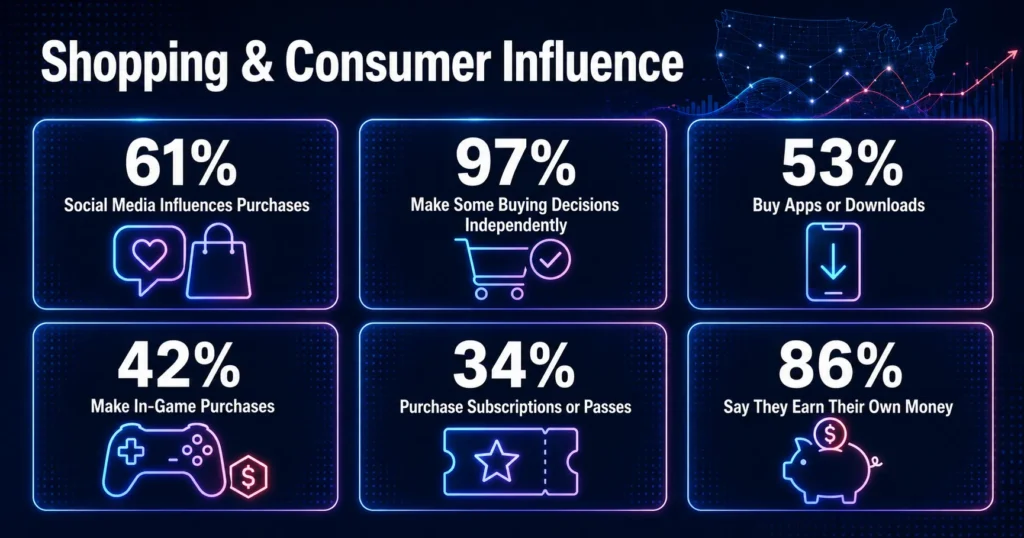
PwC’s 2026 survey found that 61% of children ages 7–14 said social media made them want to purchase something. The influence appeared even among younger respondents: 57% of 7- to 9-year-olds said social media affected what they wanted to buy.
Children reported influence across several categories. Ninety-seven percent said they made purchasing decisions independently at least some of the time. Seventy-two percent bought food and drinks, 57% bought toys and 55% bought clothing. Digital spending was also common: 53% purchased apps or one-time downloads, 42% made in-game purchases and 34% bought subscriptions or passes.
The survey also identified a gap between children’s and parents’ reports. Twenty-four percent of children said they independently ordered through shopping apps or websites, compared with 19% of parents who believed their child did so. For food-delivery apps, 25% of children reported independent use, while only 14% of parents reported it.
Gen Alpha’s own access to money is developing early. Eighty-six percent of children said they earned money, commonly through chores, performance in school or activities, and small jobs. Cash remained common, but digital-wallet use increased with age.
These statistics matter for parents as well as businesses. Families need clear rules for saved cards, in-app purchases, delivery services and advertising. Companies serving children should prioritize age-appropriate design, transparent marketing, privacy and parental authority rather than treating children as ordinary adult consumers.
What These Statistics Mean for Parents and Educators
The clearest lesson is not that every Gen Alpha child is addicted to screens or fluent in AI. It is that access arrives early while judgment, literacy and safeguards develop gradually.
Parents can respond by keeping devices out of bedrooms at night when appropriate, reviewing privacy and purchase settings, discussing advertising, and asking children how they use AI rather than assuming. A family rule should address what children do online, who they communicate with and what information they share—not only the number of minutes on a device.
Educators face a similar challenge. Students need practical AI literacy: how to check sources, recognize fabricated information, protect personal data, distinguish assistance from academic dishonesty and explain their own reasoning. Rules without instruction may tell students what is prohibited without teaching them how to use emerging tools responsibly.
For researchers and journalists, the data also call for precision. Gen Alpha spans toddlers, elementary-age children, tweens and teenagers. A result from 13- to 17-year-olds should not be presented as though it describes the whole generation.
Methodology and Limitations
This article compiles the newest credible U.S. data available through August 18, 2026. It prioritizes federal statistics and large, transparent surveys. It does not combine results into a single original estimate.
Important limitations include:
- Generation Alpha has no official federal birth-year definition.
- Several national studies use age ranges that overlap with Gen Z or Generation Beta.
- Many technology and shopping figures are self-reported by children or parents.
- Different studies define screen time, AI use, ownership and “regular use” differently.
- Technology habits change quickly, so figures should always be read with their survey date.
These limitations do not make the statistics unhelpful. They show why responsible reporting should name the population, year and source rather than attaching a percentage to an entire generation without context.
Frequently Asked Questions
How old is Generation Alpha in 2026?
Using the 2010–2024 birth range, Generation Alpha is approximately 2 to 16 years old in 2026. The exact age depends on a person’s birthday. Other organizations may use slightly different generational boundaries.
How many Gen Alpha children live in the United States?
There is no official exact count because the U.S. Census Bureau does not classify the population by named generations. Census QuickFacts reports that people under 18 represented 21.1% of the U.S. population in July 2025, but that group is not identical to Generation Alpha.
What percentage of Gen Alpha owns a smartphone?
PwC’s 2026 U.S. survey found smartphone ownership of 46% among children ages 7–9 and 89% among ages 13–14. Ownership therefore varies greatly by age, and a single percentage for the entire generation would be misleading.
How much screen time does Generation Alpha have?
Common Sense Media reported about 2.5 hours of daily screen-media use among U.S. children ages 0–8 in 2025. PwC reported 3.6 hours of daily recreational screen use among ages 7–14 in 2026. The figures measure different age groups and types of use.
What percentage of Gen Alpha uses artificial intelligence?
Common Sense Media found that 86% of U.S. children ages 9–17 had used AI in its 2026 survey, with nearly one-quarter using it daily. Because the sample includes 16- and 17-year-olds and excludes younger children, the result should not be applied unchanged to the full generation.
Does Generation Alpha influence family purchases?
Yes. In PwC’s 2026 survey, 97% of U.S. children ages 7–14 said they made at least some buying decisions independently, and 61% said social media made them want to purchase products. Influence varied by product category and did not necessarily mean children completed purchases without adults.
Final Takeaway
Generation Alpha in the United States is diverse, highly connected and already using AI, smartphones and digital commerce at meaningful levels. Yet the generation is not a single type of child. Its members range from toddlers to high-school students, and their experiences vary by age, household, location and access.
The most useful Generation Alpha statistics for 2026 are therefore the ones presented with clear age ranges and credible sources. For parents and educators, the goal should be neither panic nor blind enthusiasm. It should be helping children build the judgment, safety skills and human abilities needed to grow up well in a technology-rich world.
Editorial note: This article summarizes publicly available U.S. population and survey data. It distinguishes age-specific findings from generation-wide claims and will be updated as newer national evidence becomes available.
Sources
- U.S. Census Bureau QuickFacts: United States
- U.S. Census Bureau: Vintage 2025 Population Estimates by Age
- U.S. Census Bureau: Racial and Ethnic Diversity of Adults and Children
- National Center for Education Statistics: Fall 2023 Public-School Enrollment
- McCrindle: Understanding Generation Alpha
- PwC Generation Alpha Survey 2026
- Common Sense Census: Media Use by Kids Zero to Eight, 2025
- Common Sense Media Census: AI Use by Tweens and Teens, 2026
- Pew Research Center: Teens, Social Media and AI Chatbots 2025
- Pew Research Center: How Teens Use and View AI
One Comment