
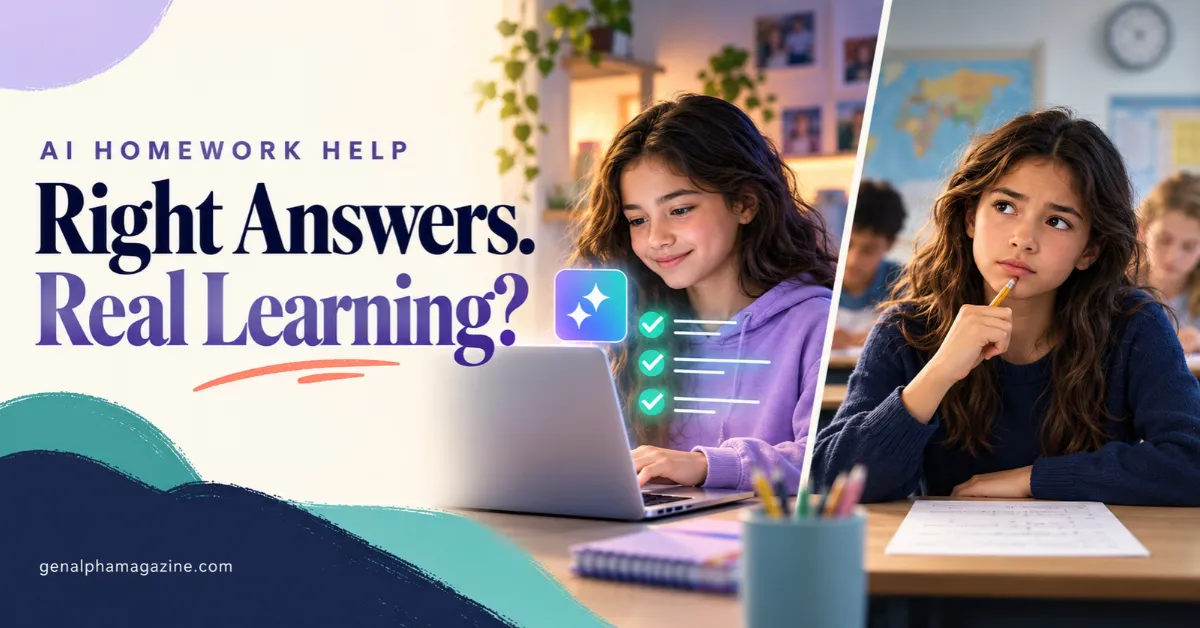
AI homework help can make your child’s assignments look better than ever. The answers are correct. The explanations sound clear. Homework gets finished with fewer complaints.
Then a test comes home, and the marks tell a different story.
You ask what happened. Your child says, “But I understood everything when I was studying.”
They may be telling the truth. An explanation can make sense while it is on a screen. Recreating that reasoning without help is a different task.
Getting an answer right with support does not always mean your child can solve a similar problem independently. Here is how that gap develops and how you can check whether real learning is happening.
Table of Contents
Why AI Homework Help Does Not Always Lead to Better Test Results
Homework and tests can ask children to work under very different conditions.
At home, your child may have an AI tool explaining every step, suggesting a formula, or organizing a paragraph. During a test, they need to decide what to do themselves.
Consider this math question:
3x + 6 = 21
AI explains that you subtract six from both sides, then divide by three. Your child follows the solution and writes down the correct answer: x = 5.
But following those steps does not tell you whether they could choose the steps themselves.
Did they understand why six was subtracted? Could they explain why both sides must be divided by three? Would they recognize the same method in a word problem?
A correct homework answer shows successful completion. Independent practice helps reveal understanding.
The same issue can appear in other subjects. A child might submit an excellent paragraph about a story but struggle to explain which details support it. They might read a clear science explanation without being able to describe the process later.
What Research Says About AI Homework Help
A 2025 study published in PNAS examined AI-supported math practice with nearly 1,000 high school students in Turkey.
Students using a general GPT-4-based interface performed better during supported practice. However, when AI access was removed, they performed worse than students who had practiced without that support. A tutor version designed with learning safeguards largely avoided this harm.
The study on generative AI and student learning does not prove that all AI tools harm learning. It studied particular tools, students, and lessons.
It does highlight an important distinction: better work while using AI does not automatically mean better performance without it.
For parents, the useful question is how much thinking the child is doing during the process.
Getting Answers vs. Understanding Lessons
The difference becomes easier to see when you look beyond the finished page.
| When your child gets an answer with help | When your child shows understanding |
|---|---|
| Copies the steps from an explanation | Explains why a step is needed |
| Recognizes a definition on the screen | Describes the idea without looking |
| Repeats a worked example | Applies the method to a similar question |
| Accepts a polished paragraph | Supports an argument with evidence |
| Corrects an answer after being told | Identifies and explains the mistake |
Your child does not need to demonstrate every skill perfectly after one lesson. These are useful checks, not a grading system.
They help you identify what still needs practice.
Four Ways AI Can Hide Gaps in Learning
1. Your child sees the solution before attempting the question
If opening AI becomes the first step for every assignment, your child may get little practice deciding how to begin.
An initial attempt does not need to be long. They could underline important information, choose a possible formula, or write what confuses them.
“I understand the question, but I don’t know which operation to use” is a useful starting point for help.
2. A clear explanation creates a feeling of understanding
When every step is visible, the solution can feel obvious.
That feeling may disappear when the screen closes.
Instead of only asking, “Does that make sense?” try asking, “How would you start this yourself?”
The second question gives you more information about what your child can do.
3. Your child learns one pattern without knowing when to use it
A student may repeat the method from an example successfully. Then a test changes the wording or combines two familiar ideas, and they become stuck.
They need practice recognizing when a method applies, as well as carrying it out.
4. AI writes the explanation that would expose confusion
Writing can reveal missing knowledge.
A child may discover that they cannot explain why a character made a decision or how a scientific process works. If AI writes that explanation immediately, the uncertainty can remain hidden.
The paragraph sounds complete even though the child’s understanding is still developing.
Five Practical Ways to Check Learning After AI Homework Help
Keep these checks short and friendly. Choose one or two rather than turning every homework session into an exam.
1. Close the screen and ask for the first step
After your child reads an explanation, hide it.
Ask:
“What would you do first, and why?”
For 3x + 6 = 21, they might say, “I would subtract six from both sides to get the term with x on its own.”
They do not need to use formal language. Listen for the reasoning.
If they cannot begin, revisit that specific step together.
2. Change one part of the question
Once your child understands the original equation, try:
4x + 6 = 22
The answer is x = 4, and the method is similar.
Can they solve it without looking back?
Choose a question at the same level, preferably from their textbook. A much harder problem will not give you a fair comparison.
For another subject, you could ask them to apply a science concept to a different everyday example.
3. Let them explain, draw, or demonstrate
Ask:
“How would you explain this to someone who missed the lesson?”
Your child might draw a diagram, use objects, write a few steps, or explain aloud.
For reading, ask them to point to a sentence that supports their answer. For fractions, let them draw divided shapes.
Do not judge understanding only by confident speech or polished English. Give them a way to show what they know.
4. Ask them to explain a mistake
Try presenting a simple incorrect answer:
“Someone says one-half plus one-third equals two-fifths. What went wrong?”
A useful explanation would recognize that the fractions need a common denominator before adding.
If your child can spot the error but cannot explain it, that gives you a clear place to focus.
Use familiar material. The aim is to explore their reasoning, not catch them out.
5. Return to the lesson the next day
Ask one short question with the notes and AI tool closed.
Recalling information from memory is called retrieval practice. It can strengthen learning and help students notice what they have not yet mastered. Feedback helps correct errors after an attempt.
The Retrieval Practice guide explains why these activities can be useful without giving children marks or grades.
If your child forgets, offer a small cue, review the explanation, and let them try again.
How to Use AI Homework Help More Effectively
Try a simple routine:
Attempt the question → Ask for a hint → Complete the work → Check independently
First, encourage your child to make an attempt. If they are unsure, ask them to identify the exact point where they get stuck.
Next, use AI for a limited piece of support. A hint or explanation of one step may be enough.
Then let your child finish the work.
Finally, close the tool and try one short, similar question.
If the topic is completely unfamiliar, studying a worked example first can be useful. Discuss why each step happens, then try a new question with the example hidden.
Follow the teacher’s rules on AI use and use tools appropriate for your child’s age.
AI Prompts That Encourage Your Child to Think
The request your child makes can shape the help they receive. These prompts aim to keep them involved.
To get started:
“Here is my attempt. Give me one hint about what to do next. Do not solve the whole question.”
To check working:
“Identify the first incorrect step in my working. Ask me a question that helps me correct it.”
To understand a method:
“Explain why this step works using a simple example. Then ask me to explain it back.”
To practice independently:
“Give me one similar question at the same difficulty. Wait for my answer before showing the solution.”
To improve writing:
“Read my paragraph and ask two questions about ideas that need more explanation. Do not rewrite it for me.”
These prompts do not guarantee accurate answers or good teaching. Check uncertain explanations against class materials or ask the teacher.
What If Your Child Understands at Home but Still Struggles in Tests?
AI use does not explain every disappointing result.
Look at the mistakes on the test. Did your child choose the wrong method, misunderstand the wording, forget key information, or leave questions unfinished?
If they can answer similar questions independently at home, discuss the difference with their teacher.
You could say:
“My child can solve similar questions at home without AI, but their test results are lower. Could we look at the mistakes together and identify what needs practice?”
If your child also struggles independently at home, share that too. It gives the teacher a more accurate picture than completed homework alone.
Keep any agreed learning supports in place when checking understanding. Removing support your child normally needs can make the comparison misleading.
Also, check our guide on: Your Child Deleted the App. Why Are You Still Being Charged After Deleting an App?
How to Discuss AI Homework Without Starting an Argument
Begin with curiosity.
Try:
“Let’s choose one question and see which parts you can do on your own.”
If your child cannot answer, avoid treating it as proof that they were lazy or dishonest. They may have genuinely believed that following the explanation meant they understood it.
A more useful response is:
“This part still needs practice. Show me where it starts getting confusing.”
Praise the actions that help learning: making an attempt, asking a specific question, noticing an error, or explaining a step.
Your child needs to feel comfortable showing confusion. That makes it easier to get the right help.
Frequently Asked Questions About AI Homework Help
Can AI help children understand homework?
It can provide explanations, examples, and feedback. Its usefulness depends on the accuracy of that support and how actively the child participates. Follow the explanation with a short independent attempt.
Should I stop my child from using AI for homework?
Start with the school’s rules and your child’s age. Where AI use is permitted, focus on whether it supports learning. If your child regularly cannot explain submitted work, adjust the routine and speak with their teacher.
How can I tell whether my child actually understands a lesson?
Ask them to explain a step, solve a similar question, or apply the idea to a new example without AI. Try again on another day. One difficult attempt is a starting point for support, not a final judgment.
Is asking AI for hints better than copying answers?
Hints leave more decisions for the child to make. They are most useful when your child attempts the next step and later checks whether they can work independently.
Ask What Your Child Learned, Not Only What They Finished
AI homework help is most useful when your child leaves the session able to do something they could not do before.
After homework, ask one small question:
“Can you show me how you would do this without help?”
Their answer can reveal a successful lesson, a missing step, or a useful question for the teacher. Each gives you something more valuable than a perfectly completed page alone.