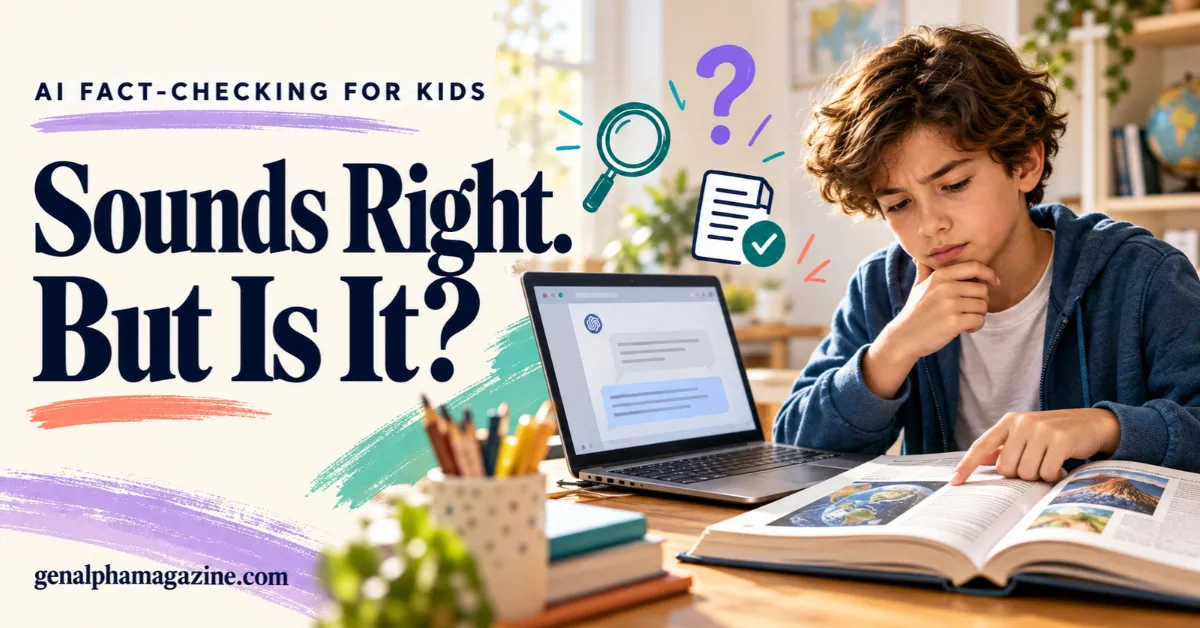
AI fact-checking for kids starts with a simple lesson: an answer can sound confident and still be wrong.
Imagine your child asks an AI tool for help with a school project. It responds immediately. There are clear explanations, specific dates, and even a list of sources.
Your child copies the information. It looks trustworthy.
But what if one date is incorrect? What if the source does not support the claim? What if a convincing quotation never appeared in the book?
Children need to know how to check an answer, even when nothing about it looks suspicious.
That does not mean researching every sentence for hours. A few practical habits can help your child decide what to trust, what to question, and when to ask for help.
Table of Contents
Why AI Can Give Wrong Answers That Sound Right
Generative AI can produce fluent explanations without guaranteeing that every statement is accurate.
The International Labour Organization’s guide to generative AI risks explains that these tools can generate convincing but incorrect information, often called “hallucinations.” It also notes that checking the underlying sources can be difficult.
For a child, you can explain it like this:
“AI can give a useful explanation, but we still need to check whether the important facts are correct.”
Avoid teaching children that mistakes always look strange. A wrong answer may have excellent grammar and a calm, helpful tone.
Specific numbers, professional wording, and a long reference list are not proof.
What Should Your Child Check First?
Start with claims that matter to the assignment or decision.
A wrong date in a history project needs checking. So does a quotation used in an essay or a statistic that supports an argument.
For a simple brainstorming task, checking every suggestion may be unnecessary. If your child asks for imaginary names for a story character, there may be no factual claim to verify.
Use this question:
“Would it matter if this detail were wrong?”
If the answer is yes, give it more attention.
| What AI provides | A useful way to check |
|---|---|
| A historical date | Consult a museum, archive, textbook, or reliable reference work |
| A quotation from a book | Find the exact wording in the original text |
| A statistic | Locate the original report and check the date and population |
| A math solution | Recalculate and test whether the answer satisfies the question |
| A school rule or deadline | Check the school’s official information |
| Information about an unfamiliar website | Investigate what independent sources say about it |
The right source depends on the claim. A school is the best source for its own homework deadline. It is not automatically an authority on every scientific topic.
A Simple AI Fact-Checking Routine for Kids
Teach your child four steps:
Pick the claim → Find the source → Read the evidence → Decide
This keeps the task manageable. They do not have to investigate the whole answer at once.
1. Pick one claim to check
Ask your child to underline one statement that could be verified.
For example:
“A survey found that 80% of students use AI every day.”
This sentence contains several details worth checking. Who counted as a student? Where did the survey happen? When was it conducted? Did it really ask about daily use?
A broad statement becomes easier to investigate when your child identifies exactly what it claims.
2. Find the actual source
If AI supplies a link, open it.
If it names a report without providing a usable link, search for the report title and the organization that supposedly published it.
Ask:
“Can we find the original material?”
A source title written inside an AI answer is a lead to investigate. It is not evidence on its own.
A broken link does not automatically prove that the claim is false. However, the claim remains unverified until your child finds reliable support.
3. Read the evidence in context
Finding a real page is only the beginning.
Your child needs to check whether it actually supports the statement.
A report might say that 80% of students in one small survey had tried AI at least once. That would not support the much broader claim that 80% of all students use it every day.
Look at the surrounding paragraph, table heading, or explanation. Search snippets and isolated sentences can leave out important qualifications.
4. Decide what the evidence allows you to say
After checking, your child might conclude:
- The source supports the claim.
- The claim needs more precise wording.
- The source contradicts the claim.
- There is not enough evidence to decide.
“I could not verify it” is a valid conclusion.
Your child does not need to force every uncertain statement into “true” or “false.”
Teach Your Child to Leave the AI Answer
One useful checking habit is to step outside the page or tool making the claim.
The Digital Inquiry Group teaches lateral reading: leaving an unfamiliar website to investigate what other sources say about it. Its lessons encourage students to examine who is behind information instead of relying on how trustworthy a page looks.
For children, the instruction can be simple:
“Open another tab and find out who is telling us this.”
If an unfamiliar website calls itself a leading education research institute, search its name elsewhere. Look for credible information about the organization, its work, and the people responsible.
You can explore the Digital Inquiry Group’s lateral reading lessons together.
A professional design, impressive name, or familiar-looking logo should not end the investigation.
Why Two Matching Websites Are Not Always Enough
“Check two sources” is a useful starting point, but it needs one extra question:
“Are these sources independent?”
Two websites may repeat the same article. Several posts may trace back to one unsupported statement.
Agreement becomes more useful when the sources have their own evidence or point to an original source you can inspect.
For a school deadline, one current official notice may be more useful than several parent discussion posts. For a disputed claim, your child may need multiple credible sources and help understanding why they disagree.
The goal is reliable evidence, not simply collecting matching answers.
How to Check Different Types of AI Answers
Check dates and current information
Ask whether the answer applies to the right year and place.
An old page may accurately describe a previous policy while being unsuitable for a question about the current one.
Teach your child to check both the publication date and the date of the event being discussed. An article published today can still describe something that happened years ago.
Check quotations in the original text
If AI provides a quote for an essay, find it in the book, speech, interview, or document.
The wording should match. The surrounding passage should also support the interpretation.
If your child cannot locate the quote, they should not present it as someone’s exact words.
A summary can be useful, but it must be clearly identified as a summary and accurately reflect the source.
Check statistics beyond the percentage
A number needs context.
Ask who was studied, how many people were included, where the research happened, and when the information was collected.
A survey of one school cannot automatically describe every child in the country.
Also check what was measured. “Has tried AI” and “uses AI daily” are different claims.
Check math by testing the result
Math offers a direct way to check some answers.
Suppose an AI response says:
4x + 6 = 22, so x = 7.
Substitute seven into the original equation:
4 × 7 + 6 = 34
That does not equal 22, so the answer fails the check.
Solving correctly gives x = 4:
4 × 4 + 6 = 22
Encourage your child to check units, signs, and whether the answer makes sense as well.
Is Asking AI “Are You Sure?” Enough?
No. Asking again may help reveal an error, but it is not an independent check.
The tool may repeat the answer, change it, or offer another explanation. Your child still needs evidence outside that exchange.
Try more useful questions:
“Which exact claim in your answer needs verification?”
“Give me the original source for this statistic, including its title and date.”
“Does the source say this directly, or are you drawing a conclusion?”
“What information would change this answer?”
Then check the response.
These prompts can guide an investigation. They cannot replace it. Asking a second chatbot is also not a substitute for examining reliable evidence.
A Five-Minute AI Fact-Checking Activity for Families
Choose one factual statement from an AI answer your child has already used.
Ask them to explain what would count as evidence. Then find a suitable source together.
Read the relevant passage and compare it with the original claim.
Finish by asking:
“Would you keep this sentence, change it, or leave it out?”
If the claim is correct, that is still a successful activity. The purpose is to practice verification, not prove that AI is always wrong.
With younger children, choose the sources together. Older children can take more responsibility for finding and comparing them.
Keep the activity focused on one claim so it feels achievable.
What to Say When Your Child Believes the Wrong Answer
Avoid turning the mistake into a lecture about being gullible.
Try:
“I can see why that sounded convincing. Let’s find out what the source actually says.”
If you have accepted incorrect information yourself, acknowledge it. That makes checking facts feel like a shared habit.
Praise the checking process:
“You noticed the date was old.”
“You found the original report.”
“You changed your answer when the evidence changed.”
These are useful skills even when the first answer was wrong.
Also, check Why Does Everyone Hate Gen Alpha? Behind the Online Backlash
Frequently Asked Questions About AI Fact-Checking for Kids
Can children trust AI answers?
They can use them as a starting point, but important factual claims need checking. Clear wording and confident presentation do not establish accuracy.
What is the easiest way to start?
Choose one important claim and compare it with a suitable original or authoritative source. Ask whether that source supports the exact wording.
Does an AI answer with citations mean it is correct?
No. Open the references, check that they exist, and read the relevant material. A real source may still be used inaccurately.
What if two reliable sources disagree?
Check whether they discuss the same date, place, definition, or group. If the difference remains unclear, ask a teacher or librarian for help rather than choosing the answer that feels most convenient.
Should children check every AI-generated sentence?
Focus first on important facts, quotations, statistics, current information, and claims they plan to submit or share. The amount of checking should match the consequences of getting something wrong.
Make “How Do We Know?” a Normal Question
Your child does not need to distrust every answer. They need to recognize the difference between a convincing statement and a supported one.
The next time AI provides a polished explanation, ask:
“What evidence would help us check this?”
That small question helps turn passive acceptance into active learning.