If your child says something is “mid,” tells you to “lock in,” or suddenly shouts “six-seven,” you may wonder if you missed an entire language lesson.
You are not alone.
Gen Alpha slang changes incredibly fast. A word can start in a gaming community, appear in a TikTok or YouTube video, spread through school hallways, and become part of everyday conversation within weeks.
Some words have clear meanings. Others are deliberately silly. And a few can mean completely different things depending on the context.
This guide explains 50 popular Gen Alpha slang words and meanings in 2026 so parents, teachers, and anyone trying to understand younger internet culture can keep up.
Table of Contents
What Is Gen Alpha Slang?
Gen Alpha slang is the collection of informal words, phrases, memes, and expressions commonly used by younger internet users.
If you are new to this generation, start with our guide to what Generation Alpha is.
Gen Alpha commonly refers to children born between 2010 and 2024, although generational boundaries vary depending on the source.
Unlike traditional slang, much of today’s youth language develops online.
TikTok, YouTube, gaming communities, Twitch streams, memes, music, and group chats can all influence how children speak.
This also explains why the language changes so quickly.
A phrase that is everywhere today may feel outdated a few months later.
50 Gen Alpha Slang Words and Meanings in 2026
Here are some of the words and expressions parents are most likely to hear.
1. 67 or Six-Seven
Meaning: It does not have one fixed meaning.
“67” is pronounced six-seven, not sixty-seven.
It became an intentionally confusing internet expression. Kids may use it as a random response, joke, reaction, or simply because other kids understand the reference.
Example:
Parent: “How was school?”
Child: “Six-seven.”
Parent note: Do not spend too much time trying to find a perfect definition. The lack of a clear meaning is part of the joke.
2. Aura
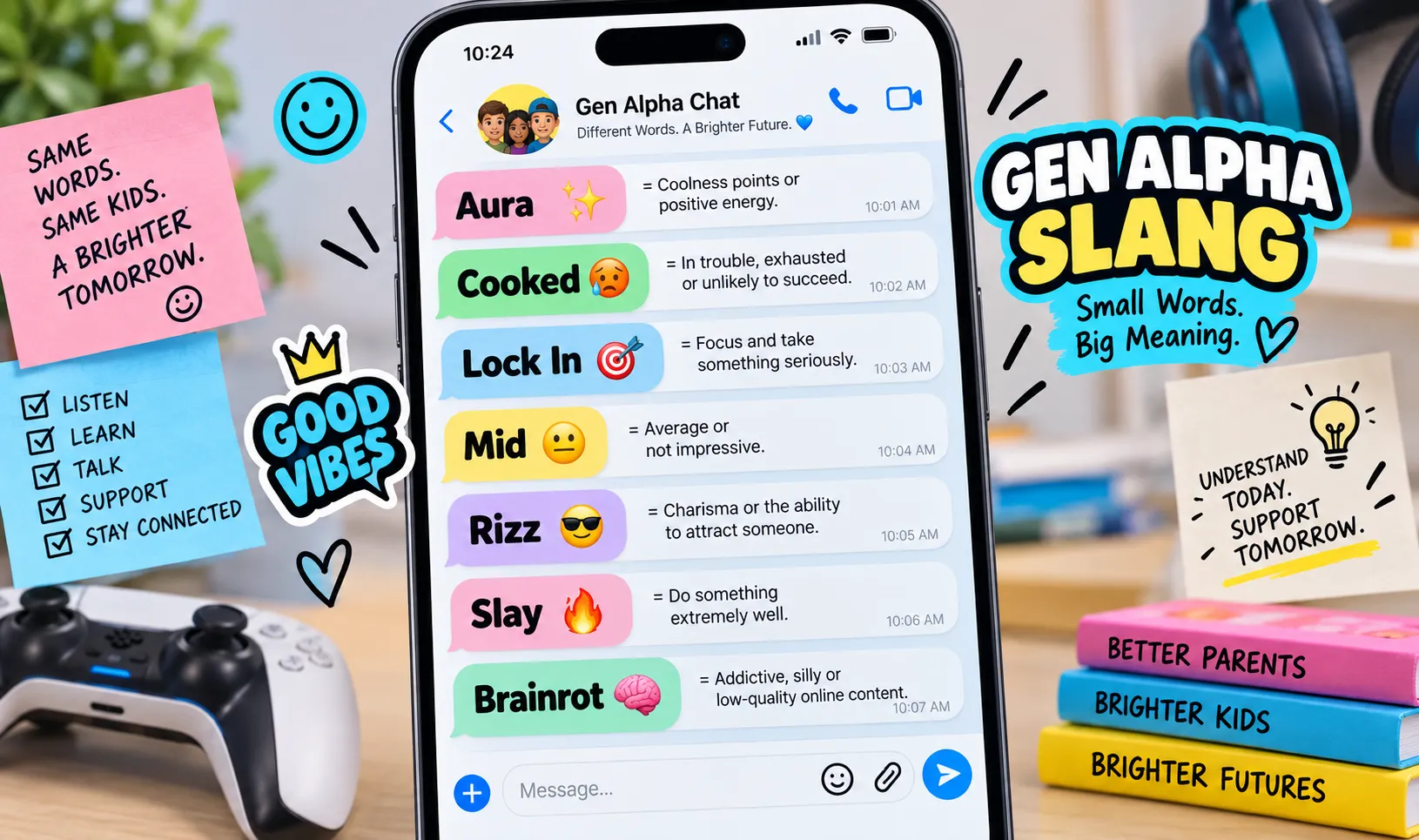
Meaning: Someone’s perceived coolness, confidence, or social presence.
A person doing something impressive may gain “aura points.” Doing something embarrassing can result in losing them.
Example: “That was +1,000 aura.”
Parent note: Think of aura as an imaginary social score.
3. Aura Points
Meaning: Imaginary points awarded or taken away based on how cool or embarrassing someone appears.
Example: “Falling in front of everyone was negative aura.”
There is no actual scoring system. It is part of the joke.
4. Sigma
Meaning: Usually someone portrayed as independent, confident, cool, or dominant.
The word grew out of older internet discussions about “sigma males,” but younger users frequently use it ironically.
Example: “That was so sigma.”
Parent note: Context matters. Children may be joking rather than seriously describing someone’s personality.
5. Gyatt or Gyat
Meaning: An expression that can show surprise or admiration, but it is also commonly used online to comment on someone’s body.
Example: “Gyatt!”
Parent note: This one deserves more attention than harmless nonsense slang. It can be used in an objectifying or inappropriate way, particularly when directed at another person’s body.
6. Rizz
Meaning: Charisma or the ability to attract or charm someone.
Example: “He has rizz.”
Someone with “W rizz” is considered charming. Someone with “no rizz” is not.
7. Brainrot
Meaning: Internet content or humor that is extremely repetitive, absurd, silly, or hard to stop consuming.
People also jokingly say they have “brainrot” when they cannot stop thinking or talking about a meme, show, game, or trend.
Example: “My feed is pure brainrot.”
It does not literally mean someone’s brain is damaged.
8. Skibidi
Meaning: A mostly nonsensical expression associated with internet meme culture.
Its meaning depends heavily on context.
A child may use “skibidi” simply because the absurdity of the word is funny.
9. Ohio
Meaning: Something strange, chaotic, bizarre, or embarrassing.
It comes from an internet meme portraying Ohio as a place where unusually strange things happen.
Example: “Only in Ohio.”
It normally has little to do with the actual U.S. state.
10. Cooked
Meaning: In trouble, exhausted, doomed, or unlikely to succeed.
Example: “I didn’t study for tomorrow’s test. I’m cooked.”
Parents can mentally translate this as: “I’m in trouble.”
11. Let Him Cook
Meaning: Give someone time to continue what they are doing because they may be onto something.
Example: “Wait. Let him cook.”
It can be sincere or sarcastic.
12. Cooking
Meaning: Performing very well or making impressive progress.
Example: “She’s cooking on this project.”
This is generally positive.
13. Ate
Meaning: Did something extremely well.
Example: “She ate that performance.”
It has nothing to do with food.
14. Ate and Left No Crumbs
Meaning: Performed exceptionally well.
It is an exaggerated version of “ate.”
Example: “That outfit? She ate and left no crumbs.”
15. Mid
Meaning: Average, mediocre, or unimpressive.
Example: “That movie was mid.”
It is usually dismissive rather than strongly negative.
16. Delulu
Meaning: Short for “delusional.”
It is often used jokingly when someone believes something unrealistic.
Example: “I’m delulu enough to think I’ll get front-row tickets.”
Context matters because casually using mental-health terminology can sometimes minimize real conditions.
17. Sus
Meaning: Suspicious.
The shortened form became especially popular through online gaming.
Example: “That sounds sus.”
This slang has been around for several years but remains easy to understand and widely recognized.
18. Cap
Meaning: A lie or something untrue.
Example: “That’s cap.”
19. No Cap
Meaning: Honestly or “I’m not lying.”
Example: “That was the best burger I’ve had, no cap.”
20. Bet
Meaning: Okay, agreed, or challenge accepted.
Example:
Friend: “Meet me at 5.”
Response: “Bet.”
It usually signals agreement.
21. Bussin
Meaning: Really good.
It became especially associated with food but can be used more broadly.
Example: “This pizza is bussin.”
22. Slay
Meaning: To do something very well or look impressive.
Example: “You slayed that presentation.”
Despite its literal meaning, it is usually positive slang.
23. W
Meaning: Win.
A “W” represents something good, successful, or impressive.
Example: “Getting Friday off school is a W.”
24. L
Meaning: Loss.
It describes something disappointing or embarrassing.
Example: “That’s an L.”
25. Common W
Meaning: Something good that is expected from a person who regularly does well.
Example: “Another common W from Mom.”
26. NPC
Meaning: Someone behaving predictably, mechanically, or without much individuality.
NPC originally means “non-player character” in video games.
Example: “He was standing there like an NPC.”
Parent note: It can be playful, but using it to dehumanize or repeatedly mock someone can become insulting.
27. Main Character
Meaning: Someone behaving as though they are the central character in a story.
It can describe confidence or self-importance.
Example: “She’s having her main-character moment.”
28. Side Quest
Meaning: A random activity that distracts from the main thing someone was supposed to be doing.
The expression comes from video games.
Example: “I went to buy milk and somehow ended up on a two-hour side quest.”
29. Lock In
Meaning: Focus seriously.
Example: “I need to lock in for finals.”
This is one of the easier Gen Alpha phrases for parents to adopt.
30. Crash Out
Meaning: To lose control emotionally or react dramatically.
Example: “He’s about to crash out.”
The seriousness depends heavily on context. Sometimes it describes ordinary frustration. In other situations, it can imply reckless behavior.
31. Unc
Meaning: Short for “uncle.”
Young people may jokingly call someone “unc” when they think the person seems old or out of touch.
Example: “Okay, unc.”
You do not actually have to be someone’s uncle.
32. Bro
Meaning: Friend, person, or sometimes simply a reaction to something ridiculous.
Example: “Bro, what are you doing?”
“Bro” has existed for decades, but younger users apply it extremely broadly.
33. Bruh
Meaning: An expression of disbelief, frustration, or surprise.
Example: “Bruh, seriously?”
34. Huzz
Meaning: Internet slang referring to girls or women.
It is often used jokingly among younger users.
Parent note: The term can be disrespectful or objectifying depending on how it is used. Context matters more than simply knowing its dictionary-style meaning.
35. Chopped
Meaning: Unattractive or looking bad.
Example: “That haircut is chopped.”
Parent note: It can easily become hurtful when used about someone’s appearance.
36. Glaze
Meaning: To praise someone excessively.
Example: “Stop glazing him.”
A person accused of “glazing” is seen as giving someone too much admiration or credit.
37. Glazer
Meaning: Someone who praises or supports another person excessively.
Example: “You’re such a glazer.”
38. Lowkey
Meaning: Slightly, secretly, or without making a big deal about it.
Example: “I lowkey like this song.”
39. Highkey
Meaning: Openly, strongly, or definitely.
Example: “I highkey want pizza.”
It is essentially the stronger opposite of “lowkey.”
40. Valid
Meaning: Good, acceptable, understandable, or worthy of approval.
Example: “That opinion is valid.”
41. Based
Meaning: Confidently expressing an opinion without worrying about others’ approval.
It can also simply mean someone agrees with what was said.
Example: “That’s based.”
The term has had different meanings in different internet communities, so context matters.
42. Tuff
Meaning: Cool, impressive, or stylish.
It is a stylized spelling of “tough.”
Example: “Those shoes are tuff.”
43. Drip
Meaning: Stylish clothes, accessories, or overall fashion.
Example: “He’s got drip.”
Someone with good drip is dressed well.
44. Fit
Meaning: Outfit.
Example: “Check the fit.”
This is different from “fit” meaning physically healthy.
45. Fire
Meaning: Excellent or exciting.
Example: “That song is fire.”
This one predates much of Gen Alpha culture but remains common online.
46. GOAT
Meaning: Greatest Of All Time.
Example: “She’s the GOAT.”
It is generally a strong compliment.
47. GOATed
Meaning: Exceptionally good or among the best.
Example: “That game is GOATed.”
48. Touch Grass
Meaning: Get offline and spend some time in the real world.
It is often said to someone perceived as spending too much time online.
Example: “Bro needs to touch grass.”
Interestingly, this is one piece of internet slang many parents may agree with.
For more on children’s digital habits, see our Generation Alpha statistics for 2026.
49. It’s Giving…
Meaning: Something creates a particular impression, style, or vibe.
Example: “It’s giving main character.”
The phrase is deliberately incomplete. Whatever follows explains the impression.
50. Vibe Check
Meaning: An informal judgment of someone’s mood, attitude, or general energy.
Example: “He passed the vibe check.”
Passing means someone or something feels good. Failing means the opposite.
Why Does Gen Alpha Slang Sound So Random?
Because sometimes it is random.
Older slang often developed through music, local communities, schools, and subcultures.
Those influences still exist. But social media can now spread a phrase across millions of screens extremely quickly.
A joke from a livestream can become a TikTok meme. That meme can appear in YouTube Shorts. Children repeat it at school, and suddenly parents across the country are searching for its meaning.
Some expressions are also funny precisely because adults do not understand them.
“67” is a good example.
Trying to force every Gen Alpha expression into a traditional dictionary definition misses part of the point.
Is Gen Alpha Slang Bad for Kids?
Not automatically.
Every generation creates and adopts informal language.
Slang can help young people express humor, identity, friendship, and a sense of belonging.
Parents do not need to ban every unfamiliar word.
However, meaning and context still matter.
Calling a funny situation “Ohio” is different from repeatedly calling a classmate “chopped.” Saying “I’m cooked” before an exam is different from using slang to comment sexually on another child’s body.
The better question is not simply:
“Is this a Gen Alpha word?”
Ask:
“How is my child using it?”
Language becomes a problem when it is being used to bully, humiliate, sexualize, threaten, discriminate against, or deliberately exclude someone.
Why Parents Should Understand Their Children’s Slang
You do not need to start saying “sigma” at dinner.
In fact, your child may strongly prefer that you don’t.
Understanding their language is still useful.
It can help you understand what children are watching, what their friends are talking about, and how their online culture is influencing offline conversations.
Gen Alpha is growing up with unusually high exposure to smartphones, YouTube, gaming platforms, social media, and artificial intelligence.
Our Generation Alpha statistics for 2026 show just how closely technology is connected to the daily lives of many American children.
Parents should therefore pay attention not only to how much time children spend online but also to what they are experiencing there.
Should Parents Use Gen Alpha Slang?
You can.
But proceed carefully.
Dropping “no cap” into a conversation may get a laugh.
Announcing that dinner is “bussin, sigma, plus 1,000 aura” may result in your child leaving the room.
And that might be exactly why you want to do it.
More seriously, parents do not need to imitate children’s language to communicate with them.
Showing genuine curiosity is more useful.
If your child uses a word you do not understand, simply ask:
“What does that mean when you and your friends say it?”
Their answer may be more useful than an online definition because slang changes between communities.
Gen Alpha Slang and Online Culture
Much of this language cannot be separated from the internet.
Terms move between gaming, memes, livestreams, music, YouTube, TikTok, group chats, and school.
That means understanding slang can sometimes give parents a small window into a child’s digital world.
It can also create opportunities for bigger conversations.
If a child repeatedly uses slang about people’s bodies, talk about respect.
If every new phrase comes from a particular creator, learn what that creator posts.
If a child is constantly repeating memes they do not understand, ask where they heard them.
And if online culture is beginning to interfere with sleep, school, exercise, or family life, it may be time to look at the bigger picture rather than focusing on individual slang words.
Parents looking for broader guidance can read our practical guide to keeping children safe online.
Gen Alpha Slang Changes Fast
This may be the most important thing to remember.
Slang is not permanent.
Some words on this list may remain popular for years. Others could disappear quickly.
Meanings can change too.
A term that begins as a meme may later become an insult, compliment, ironic joke, or something else entirely.
That is why context matters.
Rather than trying to memorize every word your child might encounter, understand the broader culture and keep communication open.
Frequently Asked Questions
What is Gen Alpha slang?
Gen Alpha slang refers to informal words, memes, expressions, and phrases commonly associated with Generation Alpha and younger online communities. Much of it spreads through social media, gaming, streaming, music, and school culture.
What are popular Gen Alpha slang words in 2026?
Popular and recognizable terms include 67, aura, sigma, gyatt, rizz, brainrot, skibidi, Ohio, cooked, lock in, crash out, unc, chopped, and huzz. Popularity varies by age, location, platform, and friend group.
What does 67 mean in Gen Alpha slang?
“67,” pronounced “six-seven,” does not have one fixed definition. It is an intentionally ambiguous internet expression that can work as a joke, reaction, random response, or social signal.
What does aura mean in Gen Alpha slang?
Aura refers to someone’s perceived coolness, confidence, or social presence. Kids may jokingly award “aura points” for impressive behavior and subtract them for embarrassing moments.
What does sigma mean to kids?
Sigma is commonly used to describe someone as independent, cool, confident, or impressive. However, younger internet users frequently use the word ironically or as part of absurd meme humor.
What does gyatt mean?
Gyatt can be an expression of surprise or admiration, but its modern internet use frequently involves comments about someone’s body. Parents should pay attention to context because the term can be objectifying.
What does brainrot mean?
Brainrot describes repetitive, absurd, highly online content or the feeling of being unable to stop thinking about a particular meme, game, show, or trend. It is normally used humorously rather than as a medical term.
Why does Gen Alpha say Ohio?
“Ohio” became part of a meme suggesting strange or bizarre things happen in Ohio. Young users may therefore describe something weird or chaotic as “Ohio.” It usually has little connection to the actual state.
Is Gen Alpha slang inappropriate?
Some Gen Alpha slang is harmless nonsense or ordinary youth language. Other terms can become insulting, sexual, or objectifying depending on how they are used. Parents should consider context rather than assuming all slang is either harmless or dangerous.
Where does Gen Alpha slang come from?
It comes from many sources, including TikTok, YouTube, Twitch, gaming, music, memes, group chats, and school communities. Terms can spread between online and offline culture very quickly.
Final Thoughts
Gen Alpha slang can sound like another language.
Sometimes it practically is.
But parents do not need to memorize a dictionary to understand their children.
Knowing the basics helps. Understanding the context helps even more.
Words such as 67, aura, sigma, gyatt, rizz, brainrot, cooked, and lock in tell us something bigger about how quickly youth culture now moves between the internet and everyday life.
Stay curious.
Ask what unfamiliar words mean.
And remember that today’s completely unavoidable slang may become tomorrow’s painfully outdated phrase.
That’s how slang has always worked.
Gen Alpha is simply doing it at internet speed.
One Comment