
Parents often ask, “How much screen time should children have by age?” The simple answer is that younger children generally need tighter limits, while older children require flexible boundaries based on what they are doing and whether screens are replacing sleep, learning, exercise or relationships.
For babies and young children, international health guidance provides clearer numerical recommendations. For school-age children and teenagers, there is no single number that works for every family.
The American Academy of Pediatrics’ updated approach considers the child, content, emotional use, activities being replaced and family communication. Its 2026 policy explains that recreational limits may range from less than one hour for toddlers and preschoolers to one or two hours—or sometimes more—for school-age children and teenagers. The appropriate amount depends on the individual child and family context. American Academy of Pediatrics
This guide provides practical screen-time recommendations by age, explains what should count as screen time and helps parents recognize when digital use is becoming a problem.
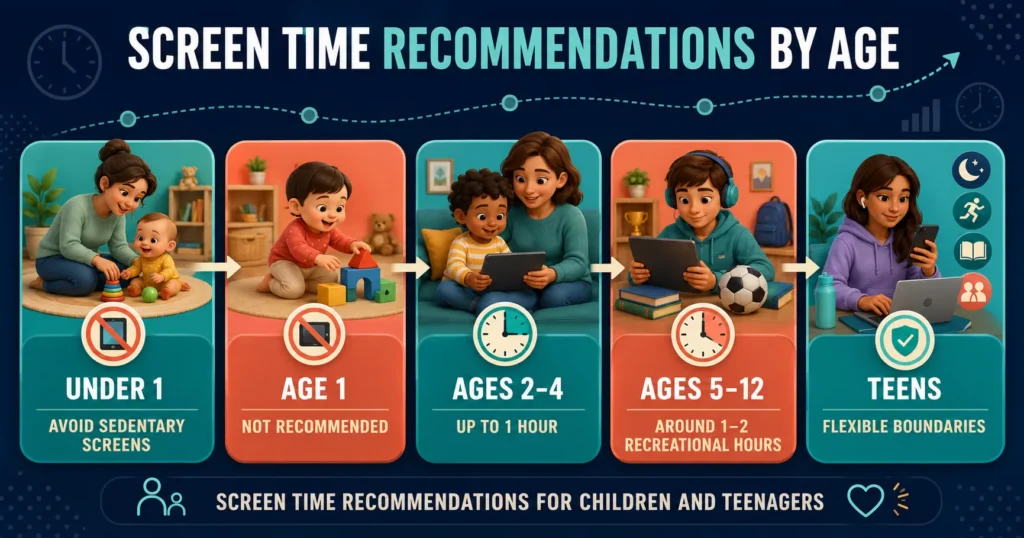
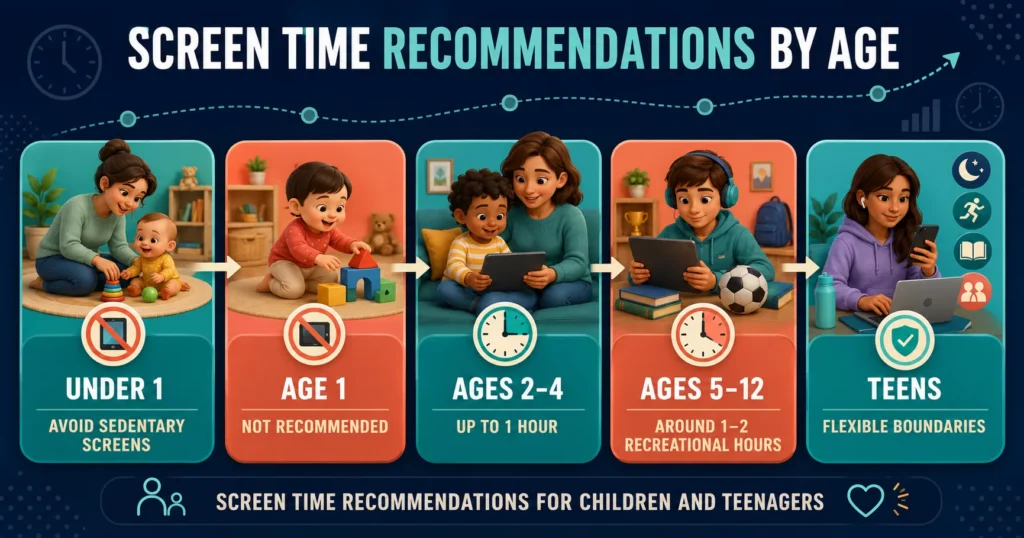
Screen-Time Recommendations by Age
The following table offers a practical summary based on guidance from the World Health Organization and the American Academy of Pediatrics.
| Child’s age | Practical screen-time guidance |
|---|---|
| Under 1 year | Avoid sedentary screen use; occasional video calls with an adult are different from passive viewing |
| 1 year | Sedentary screen time is not recommended by WHO |
| 2 years | No more than 1 hour of sedentary screen time; less is better |
| 3–4 years | No more than 1 hour of sedentary screen time; less is better |
| 5–8 years | Often around 1–2 hours of recreational screen use, adjusted for the child and family |
| 9–12 years | Commonly 1–2 hours of recreational use as a starting point, with flexibility for healthy activities |
| 13–18 years | No universal limit; protect sleep, school, physical activity and relationships, with agreed recreational boundaries |
These numbers mainly concern recreational screen time, such as entertainment videos, gaming and casual social media. Schoolwork, video calls, creative projects and accessibility-related technology should be considered according to their purpose rather than automatically treated as identical to entertainment.
The table is a starting point, not an individual medical prescription. A child’s development, disability, health, school requirements and family circumstances may require a different plan.
What Counts as Screen Time?
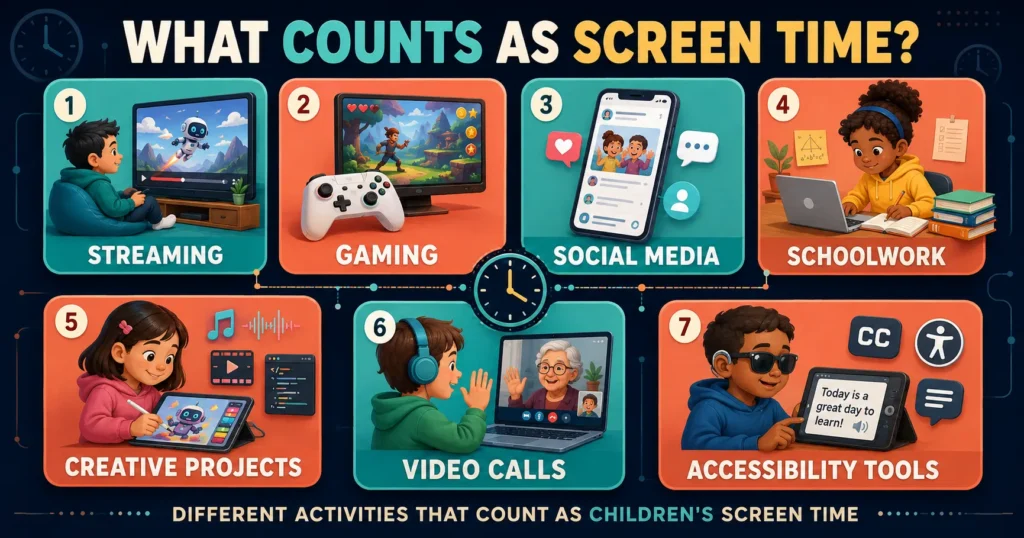
Screen time generally refers to time spent looking at or interacting with televisions, phones, tablets, computers, gaming consoles and similar digital devices.
Common forms include:
- Watching television or streaming videos
- Playing video games
- Using social media
- Watching short-form videos
- Browsing websites
- Messaging friends
- Attending online classes
- Completing digital homework
- Creating art, music or videos
- Video-calling relatives
- Using communication or accessibility tools
Not every activity has the same purpose or effect.
For example, an hour spent endlessly scrolling through short videos is different from an hour spent creating an animation, attending an online lesson or talking to a grandparent.
Parents should consider both the amount and the quality of screen use.
How Much Screen Time Should Babies Under 1 Have?
For babies under one year, sedentary screen time is best avoided.
Babies learn through face-to-face interaction, movement, touch, sound and exploration of the physical environment. They benefit from seeing facial expressions, hearing real voices and interacting with responsive caregivers.
The World Health Organization does not recommend sedentary screen time for infants under one. World Health Organization
A brief video call with a relative is different from leaving a baby to watch entertainment alone. During a video call, an adult can name the person on screen, respond to the baby and make the experience interactive.
Parents should also be aware of background media. A television playing in the room can distract both babies and caregivers, even when nobody is intentionally watching it.
Also, check our guide on Digital Parenting
Practical guidance for babies
- Prioritize talking, singing, reading and floor-based play
- Avoid using videos as a regular babysitter
- Keep screens away during feeding when possible
- Turn off background television
- Use video calls with adult participation
- Avoid screens close to bedtime
- Remember that parents’ phone habits also affect interaction
Occasional exposure is not a reason to panic. The goal is to ensure that screens do not replace the responsive human interaction babies need.
How Much Screen Time Should a 1-Year-Old Have?
The World Health Organization states that sedentary screen time is not recommended for one-year-old children.
At this age, children are developing movement, language and social understanding. Real-world play gives them opportunities to touch objects, imitate adults, practise balance and connect words with physical experiences.
If screen use occurs occasionally, keep it brief, choose simple high-quality content and participate with the child. Talk about what appears on the screen and connect it to familiar objects or people.
Avoid fast-moving, frightening or noisy content. Autoplay should also be turned off so that one short video does not automatically become a much longer viewing session.
How Much Screen Time Should a 2-Year-Old Have?
For children aged two, the World Health Organization recommends no more than one hour of sedentary screen time per day, with less being better.
This does not mean that every two-year-old needs a full hour. It means one hour should be treated as a maximum rather than a daily target.
At this age, children benefit most when an adult watches with them. Co-viewing can turn a passive activity into a conversation.
For example, a parent can ask:
- What colour is that?
- Can you find the same toy in the room?
- What sound does that animal make?
- How do you think the character feels?
Choose content with a clear story, simple language and a slow enough pace for a young child to follow.
How Much Screen Time Should Children Ages 3 to 4 Have?
For children aged three and four, WHO guidance recommends no more than one hour of sedentary screen time per day, with less being better.
Preschool children may use screens for entertainment, early learning or communication. The quality of the experience remains important.
A suitable routine might divide the hour into shorter sessions instead of allowing one continuous period. This can make transitions easier and leave more time for physical play, books and family interaction.
Parents should avoid treating every educational label as proof of quality. An application can call itself educational while containing distracting advertisements, repetitive tapping or little meaningful learning.
Look for content that encourages children to:
- Think and respond
- Use language
- Solve simple problems
- Create something
- Connect the lesson with real life
- Continue playing away from the screen
How Much Screen Time Should Children Ages 5 to 8 Have?
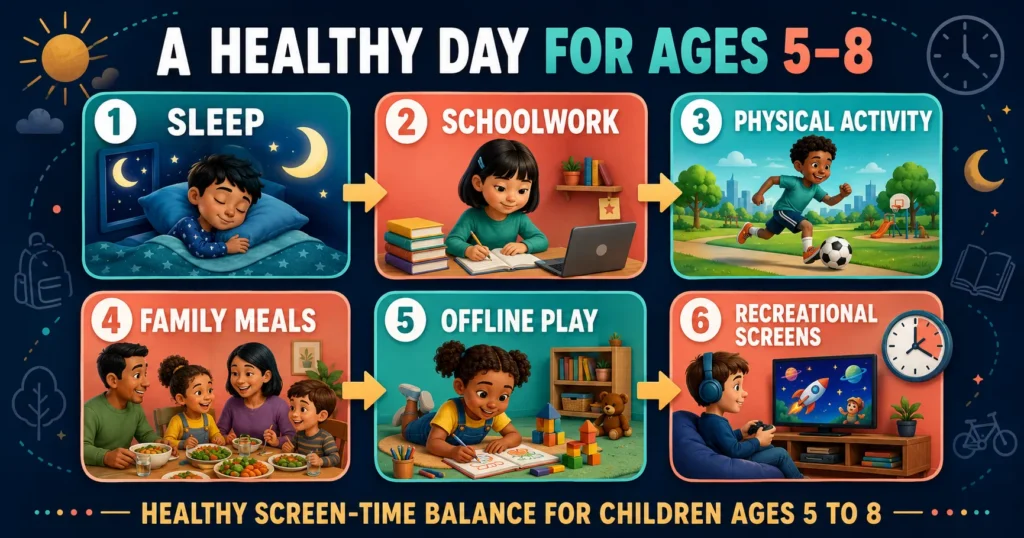
For children aged five to eight, approximately one to two hours of recreational screen time per day can be a reasonable starting point for many families.
This is not a universal medical limit. The appropriate amount depends on the child, the content and what else happens during the day.
School-age children may use computers or tablets for homework, reading, research and creative activities. These uses should be considered separately from recreational gaming, streaming and casual videos.
Instead of focusing only on a clock, ask:
- Is my child sleeping enough?
- Is homework being completed?
- Is there time for physical activity?
- Does my child play without a device?
- Are family meals regularly interrupted?
- Can my child stop when the agreed time ends?
- Is the content suitable and safe?
If these areas are going well, occasional variation may not be a major concern. Weekends, holidays, illness and long journeys may not look the same as an ordinary school day.
How Much Screen Time Should Children Ages 9 to 12 Have?
For children aged nine to twelve, one to two hours of recreational screen use may remain a useful starting point, but the plan should reflect school responsibilities, hobbies and increasing independence.
At this age, children may begin using multiplayer games, messaging services, video platforms or social media-like features. The question is no longer only how long they are online, but also what they experience there.
Parents should discuss:
- Privacy settings
- Online advertisements
- In-app purchases
- Communication with strangers
- Cyberbullying
- Location sharing
- Misleading videos and posts
- AI-generated information
- Pressure to remain constantly available
Keep devices outside the bedroom overnight when possible, and establish a clear stopping time before sleep.
Children in this age group should gradually participate in setting household rules. They may follow limits more successfully when they understand the reason and have some input into the plan.
How Much Screen Time Should Teenagers Have?
There is no single evidence-based screen-time number that applies to every teenager.
Teenagers may use screens for homework, creative work, communication, news, entertainment and social connection. Their needs also vary according to school, family responsibilities and extracurricular activities.
A recreational limit of approximately one to two hours per day may work for some teenagers, while others may manage a larger amount without losing sleep, physical activity or important responsibilities. The AAP’s 2026 policy describes possible limits as flexible rather than universal.
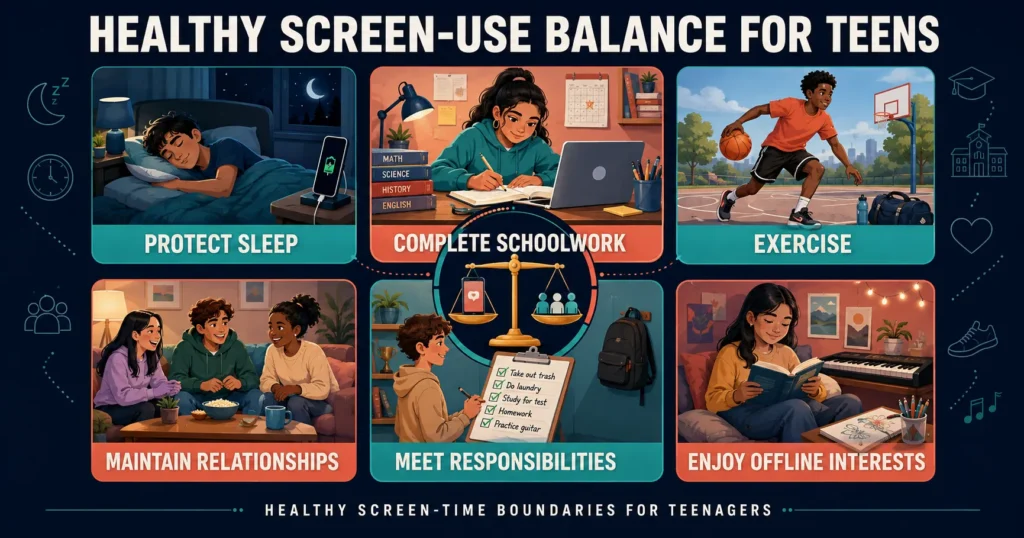
For teenagers, focus on whether screen use is crowding out:
- Adequate sleep
- Focused schoolwork
- Exercise
- In-person friendships
- Family interaction
- Household responsibilities
- Offline interests
- Emotional recovery
UNICEF recommends approaching teenagers with curiosity, looking at what technology is replacing and modelling healthy behaviour as an adult. UNICEF Screen-Time Guidance for Teens
A teenager spending several hours editing a film or completing a school project should not automatically be treated in the same way as a teenager staying awake all night scrolling.
What Are the AAP’s 5 Cs of Screen Use?
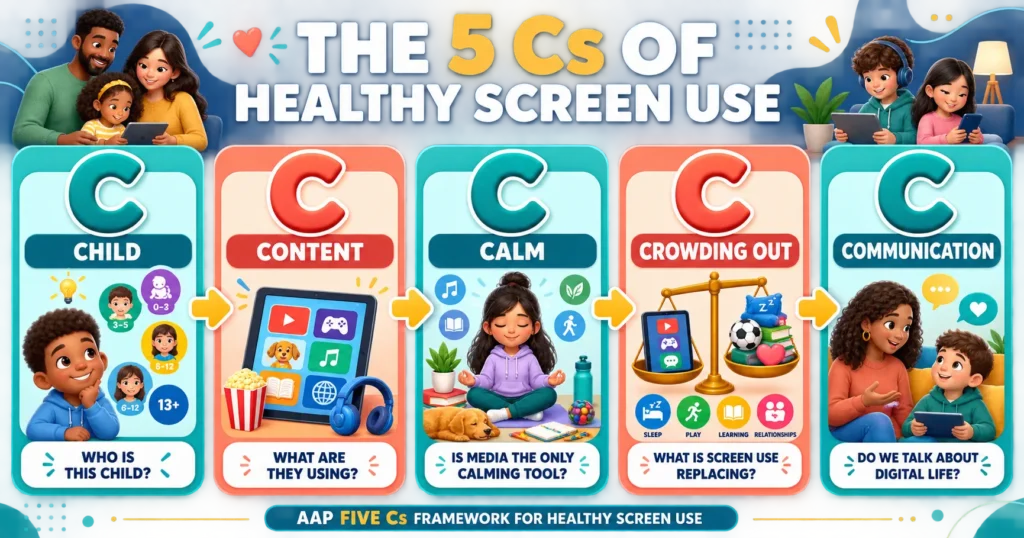
The American Academy of Pediatrics recommends looking beyond simple time limits through the 5 Cs of media use.
| The 5 Cs | Question for parents |
| Child | How does this particular child respond to media? |
| Content | What is the child watching, playing or creating? |
| Calm | Is a screen becoming the child’s only way to manage emotions? |
| Crowding Out | Is screen use replacing sleep, play, learning or relationships? |
| Communication | Does the family talk openly about digital experiences? |
The 5 Cs help parents create rules based on the child’s development and actual experience rather than relying on a single number. HealthyChildren.org
Educational vs Recreational Screen Time
Parents often wonder whether homework should count toward the daily screen-time limit.
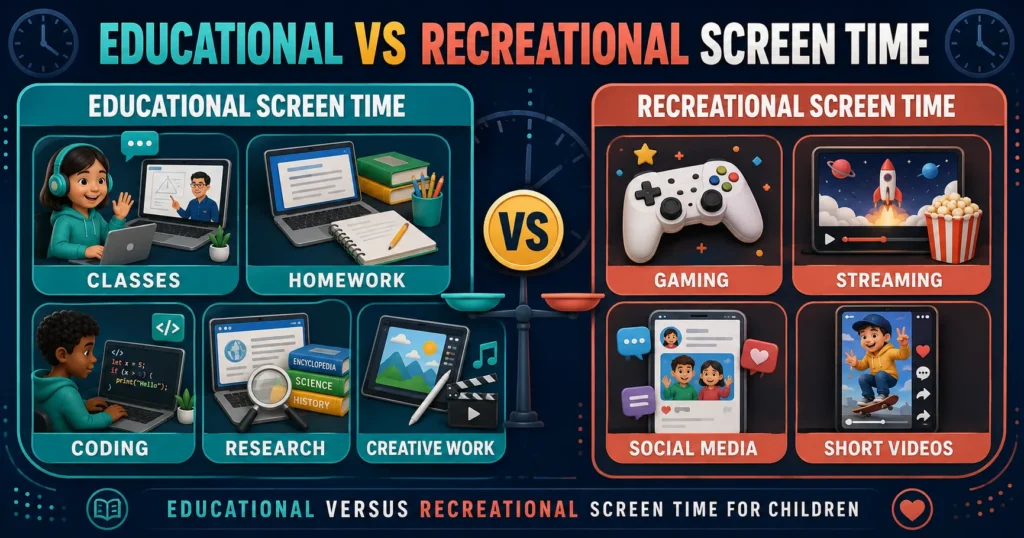
Educational and recreational screen use can be tracked separately because they serve different purposes. However, educational use still involves sitting and looking at a screen, so children need breaks, movement and protection from eye strain.
Educational screen time may include:
- Online classes
- Research
- Digital textbooks
- Homework
- Coding
- Language practice
- Creative projects
Recreational screen time may include:
- Entertainment videos
- Casual gaming
- Social media
- Short-form video feeds
- Non-educational browsing
- Streaming television
The label “educational” should not remove every limit. Parents should still examine whether the activity produces meaningful learning and whether the child has enough time for sleep, physical activity and offline experiences.
Does Video Calling Count as Screen Time?
Technically, video calling uses a screen. However, it is socially interactive and should not always be treated in the same way as passive viewing.
Video calls can help children maintain relationships with relatives and friends, especially when families live apart. Younger children benefit when an adult helps them participate by naming the person, asking questions and responding to the conversation.
The purpose and quality of the interaction are more important than simply adding every minute to an entertainment limit.
Is All Screen Time Harmful?
No. Screen use is not automatically harmful.
Technology can support education, creativity, accessibility, communication and entertainment. Problems are more likely when screen use includes harmful content or experiences, becomes difficult to control, or repeatedly replaces activities needed for healthy development.
UNICEF’s global research found no clear evidence that screen time by itself directly harms children’s mental health. It found stronger links between poor mental health and harmful online experiences such as bullying and abuse. This means safety, content and context require attention alongside time limits. UNICEF: Childhood in a Digital World
This does not mean unlimited screen use is harmless. It means parents should avoid judging digital habits only by counting hours.
Signs a Child May Be Having Too Much Screen Time
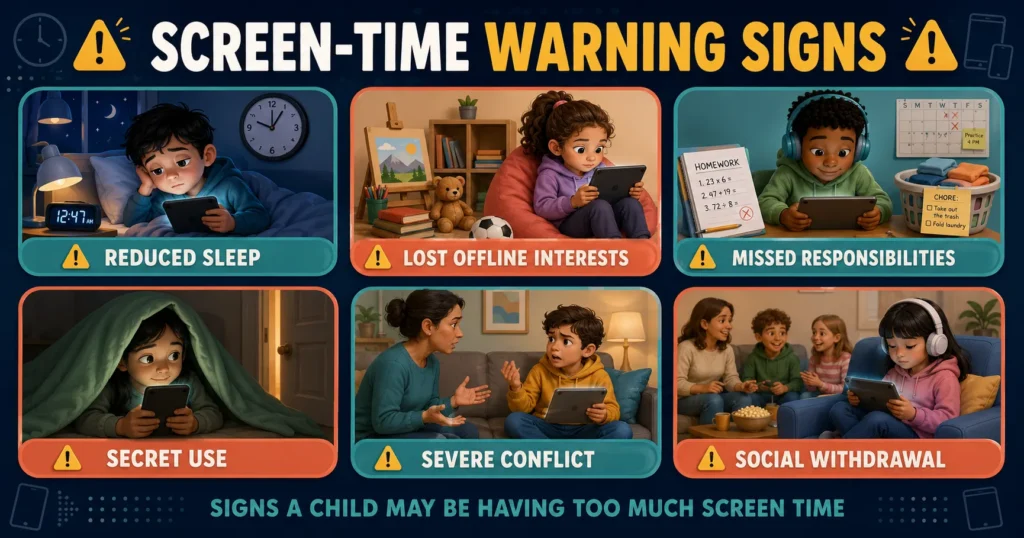
The number of hours is not the only warning sign. Screen use may require attention when it regularly causes or contributes to:
- Reduced sleep
- Difficulty waking for school
- Loss of interest in offline activities
- Avoidance of schoolwork or responsibilities
- Frequent secret use
- Continued use despite agreed limits
- Severe conflict whenever a device is removed
- Reduced physical activity
- Social withdrawal
- Use during most meals
- Physical discomfort such as headaches or tired eyes
- Contact with unsafe people or harmful content
One sign alone does not prove that a child has an addiction or medical condition. Look for continuing patterns and their effect on daily functioning.
If a child’s sleep, mood, education or relationships change significantly, speak with a qualified paediatric or mental-health professional.
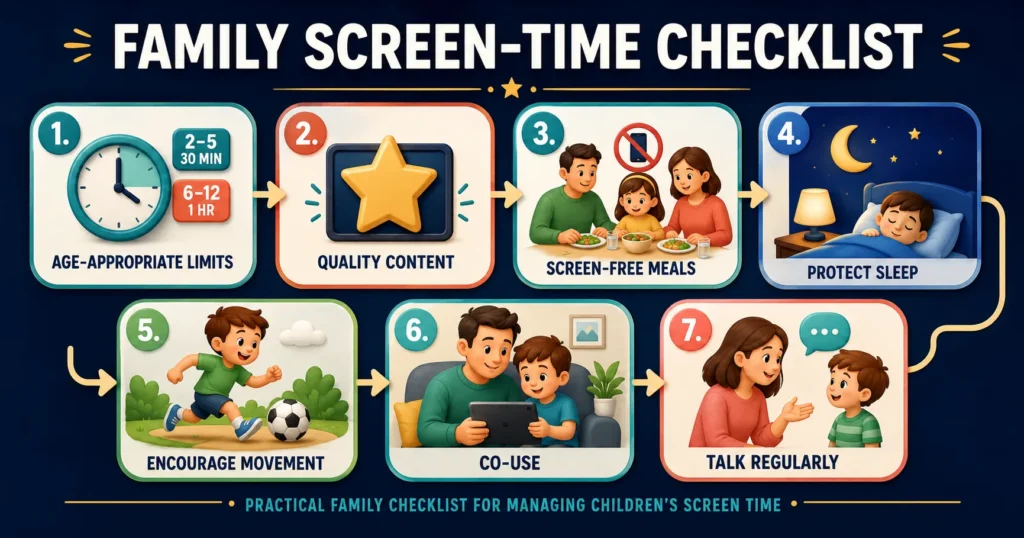
How to Set Healthy Screen-Time Limits
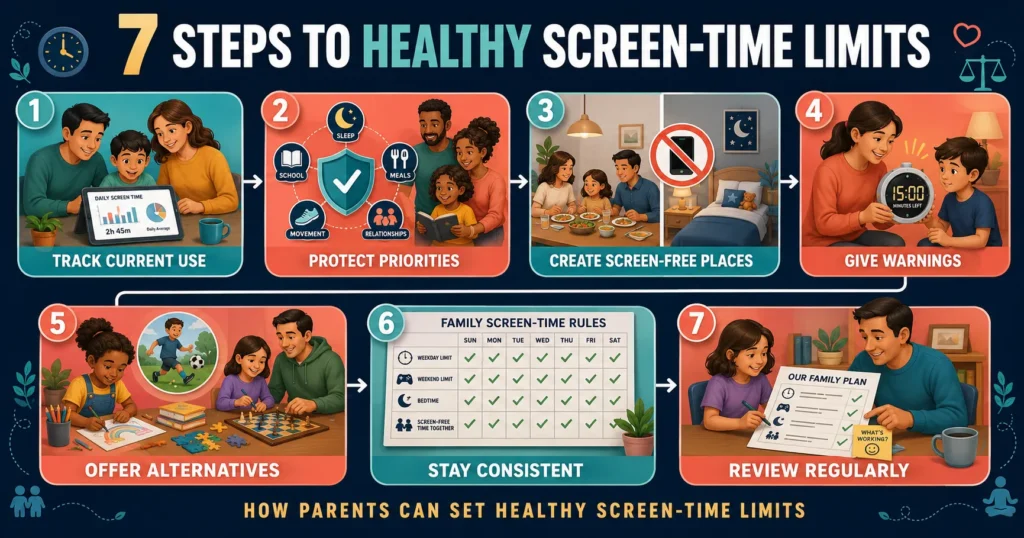
Start with the child’s current routine
Track recreational screen use for several ordinary days. Include television, games, video platforms and social media.
This gives the family a realistic starting point.
Protect important activities first
Set aside enough time for:
- Sleep
- School
- Homework
- Meals
- Physical activity
- Family interaction
- Offline play
- Personal care
Recreational screen time should fit around these priorities.
Create screen-free places
Useful screen-free areas may include:
- The dining table
- Bedrooms overnight
- Bathrooms
- Family conversations
- Homework spaces when screens are unnecessary
Give warnings before time ends
Young children may find sudden transitions difficult. Give a ten-minute and five-minute warning, and use built-in timers when helpful.
Stop at a natural point
Whenever possible, end after an episode, game round or completed activity rather than interrupting without warning.
Offer an alternative
It is easier to leave a screen when another activity is available. Suggest outdoor play, drawing, reading, cooking, a puzzle or time with a parent.
Apply rules consistently
Limits become confusing when they change unpredictably. Some flexibility is reasonable, but the usual routine should remain clear.
Review the plan regularly
Children’s schoolwork, maturity and interests change. Review rules after receiving a new device, joining a platform or beginning a new school year.
Screen Time Before Bed
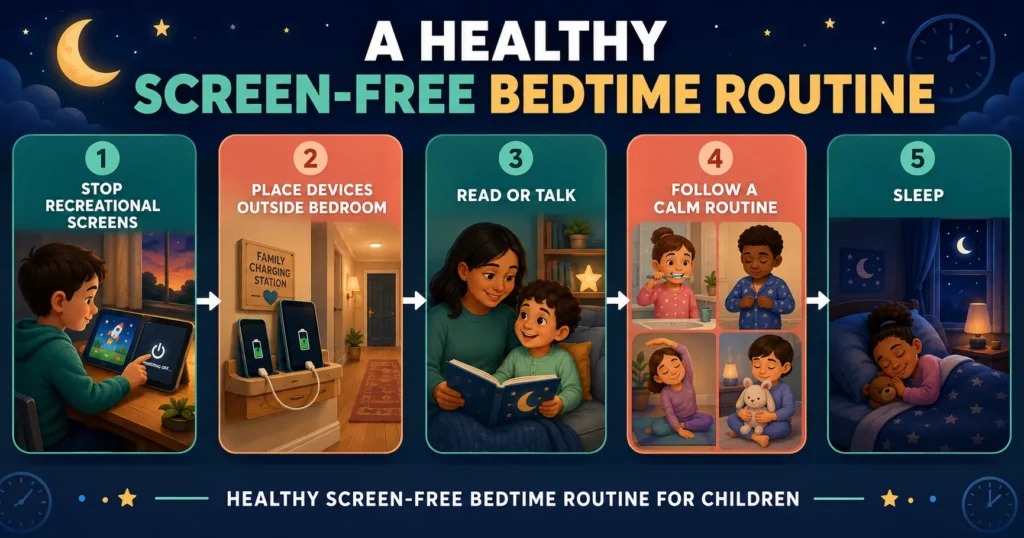
Screens can interfere with bedtime when they keep children mentally engaged, delay the routine or bring notifications into the bedroom.
A practical family rule is to stop recreational screen use before sleep and charge devices outside the bedroom. The exact interval can depend on the family, but consistency is important.
Parents can replace screens with:
- Reading
- Quiet conversation
- Preparing for the next day
- Gentle stretching
- Listening to calm audio
- A regular bedtime routine
The American Academy of Pediatrics recommends screen-free zones and times, including bedrooms and before bed, to support sleep and family connection. HealthyChildren.org Family Media Plan
What If School Requires Several Hours of Screen Use?
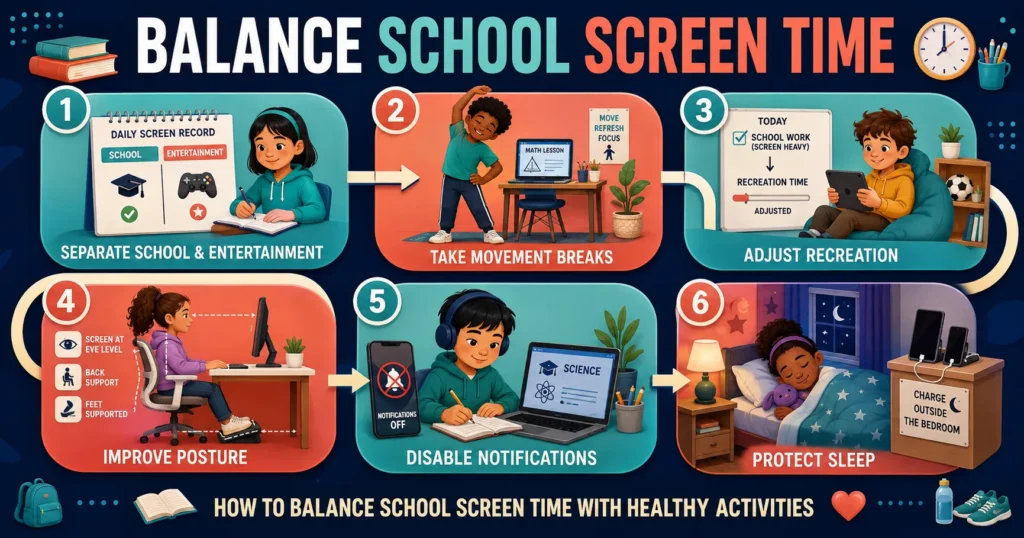
Digital schoolwork may make low total screen-time targets unrealistic.
When children need screens for education:
- Separate school use from entertainment
- Encourage regular movement breaks
- Adjust recreational use on heavy homework days
- Use printed materials when practical
- Improve seating and screen position
- Keep unnecessary notifications turned off
- Protect outdoor time and sleep
Parents can also ask teachers whether every assignment requires a screen or whether some activities can be completed offline.
The goal is not to punish children for necessary school use. It is to manage the overall day in a balanced way.
Should Screen-Time Rules Change on Weekends?
Weekend limits can be more flexible, provided screens do not take over the entire day.
Some families allow additional gaming or entertainment after responsibilities and offline activities are completed. Others keep the same daily limit throughout the week because consistency works better for their children.
A weekly recreational allowance may work for older children who can manage time independently. Younger children usually benefit from simple daily routines.
Screen-Time Rules for Different Families
Screen-time guidance must be practical. Families differ in work schedules, living arrangements, disability needs, internet access, culture and available play spaces.
A child may use a device for communication, learning support or assistive technology. That use should not be restricted automatically according to a general entertainment limit.
Parents should aim for steady improvement rather than perfection. A difficult week, long journey or period of illness does not define the family’s overall habits.
A Simple Screen-Time Plan by Age
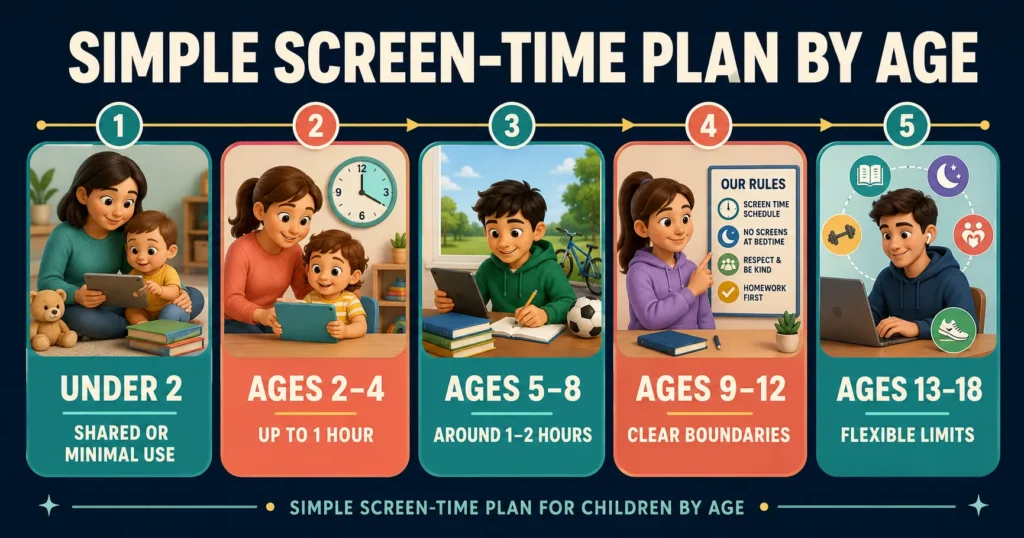
Under age 2
Prioritize human interaction and physical exploration. Avoid routine passive viewing and keep any necessary use brief and shared with an adult.
Ages 2–4
Use the WHO maximum of one hour as an upper limit, with less preferred. Choose high-quality content and participate when possible.
Ages 5–8
Begin with approximately one to two hours of recreational use. Protect sleep, school, movement, meals and offline play.
Ages 9–12
Continue with clear recreational boundaries while adding conversations about privacy, gaming, communication and online content.
Ages 13–18
Agree on flexible limits that protect essential activities. Focus on self-management, sleep, online safety and responsible independence.
Frequently Asked Questions
How much screen time should a 2-year-old have?
WHO recommends no more than one hour of sedentary screen time per day for a two-year-old, with less being better.
How much screen time should a 5-year-old have?
Approximately one to two hours of recreational use can be a practical starting point. Schoolwork and creative activities should be considered separately, while sleep, movement and offline play remain protected.
How much screen time should a 10-year-old have?
Many families begin with one to two hours of recreational screen use per day. The appropriate amount depends on the child, content, school requirements and whether screens interfere with healthy activities.
How much screen time should a teenager have?
There is no universal limit for every teenager. Families should agree on boundaries that protect sleep, schoolwork, physical activity, responsibilities and in-person relationships.
Does homework count as screen time?
Homework is technically screen use, but it can be tracked separately from entertainment. Children still need regular breaks and enough time for sleep and physical activity.
Does television count as screen time?
Yes. Television, streaming services, phones, tablets, computers and gaming consoles all contribute to total screen use.
Do video calls count as screen time for babies?
Video calls use a screen but are interactive and socially different from passive videos. An adult should help the baby participate.
Is two hours of screen time too much for a child?
It depends on the child’s age, the activity and what the screen use is replacing. Two hours would exceed WHO’s recommendation for children aged two to four, but may be a reasonable recreational limit for an older child.
Should children have screen time before bed?
It is generally better to stop recreational screen use before bedtime and keep devices out of bedrooms overnight, particularly when screens delay sleep.
When should parents seek professional help?
Seek qualified advice when screen use is connected with continuing problems involving sleep, mood, school performance, physical health, relationships or the child’s ability to manage everyday responsibilities.
Final Thoughts
So, how much screen time should children have by age?
For babies and one-year-olds, sedentary screen use should generally be avoided. For children aged two to four, the World Health Organization recommends no more than one hour per day, with less being better.
For school-age children and teenagers, one to two hours of recreational use may be a practical starting point, but there is no universal number suitable for every child.
Parents should consider the child, content, purpose and context. The most useful question is not simply, “How many hours did my child use a screen?” It is also, “What did the screen add to—or remove from—their day?”
Healthy screen use should leave enough space for sleep, learning, movement, relationships and offline enjoyment. Clear routines, appropriate content and regular conversation are more effective than focusing on a timer alone.
Editorial Note
This article provides general educational information and does not replace advice from a paediatrician or another qualified healthcare professional. Recommendations may need to be adjusted for a child’s development, disability, medical needs and family circumstances.
Sources
- American Academy of Pediatrics: Digital Ecosystems, Children and Adolescents
- American Academy of Pediatrics: The 5 Cs of Media Use
- World Health Organization: Screen Time for Children Under Five
- HealthyChildren.org: Family Media Plan
- UNICEF: Screen Time Guidance for Teenagers
- UNICEF: Childhood in a Digital World