
Gen Alpha The Founder Generation may sound like another new label for today’s youngest generation. But for Lemonade Lab founder Dean Horsfield, it describes something much bigger: a generation growing up with the ability to turn an idea into something real faster than ever before.
AI and other digital tools are changing the starting point for young creators.
A child with an idea no longer necessarily needs years of coding, graphic design or video-editing experience before experimenting with it. AI can help with brainstorming, writing, design, websites, videos and other parts of the creative process.
That doesn’t mean every child should become an entrepreneur.
Instead, Horsfield believes the bigger question is whether today’s technology will give children increasingly sophisticated ways to consume, or whether it can help them create.
That idea sits behind Lemonade Lab, a platform designed to help young people develop ideas, build projects and experiment with entrepreneurship.
Gen Alpha Magazine spoke with Horsfield in an exclusive written interview about his “Founder Generation” thesis, how AI is changing childhood creativity, the story behind Lemonade Lab, online safety, education, money and what entrepreneurship could look like for the next generation.
Here is our full conversation.
Table of Contents
What Does the “Founder Generation” Actually Mean?
“Founder Generation” is not an established demographic classification. It is Horsfield’s way of describing what he sees as a major shift in the opportunities available to today’s children.
Gen Alpha Magazine: You’ve described Gen Alpha as potentially becoming the “Founder Generation.” What does that term mean to you, and what are you seeing today that led you to this idea?
Dean Horsfield:
I do not mean that every child in Gen Alpha is going to start a company.
I mean they are the first generation to grow up believing that turning an idea into something real is normal.
Previous generations needed capital, technical skills, employees, distribution, or permission from gatekeepers. A child today can have an idea in the morning and use AI to help design it, build a website, create a brand, make a video, develop a product and potentially find an audience before dinner.
That is an enormous historical change.
The question is whether we build environments that help young people become creators with that technology, or whether we simply give them more sophisticated ways to consume it.
That is what I mean by the Founder Generation.
The distinction is important.
Horsfield isn’t arguing that every Gen Alpha child needs a startup. His idea is that the barrier between having an idea and trying to make that idea real is becoming much smaller.
How Is AI Changing What Kids Can Create?
Generative AI can reduce some of the technical barriers that once stood between beginners and their ideas.
But easier creation also makes skills such as judgment, communication and critical thinking increasingly important.
Gen Alpha Magazine: How do you think AI and other emerging digital tools are changing what children are capable of creating compared with previous generations?
Dean Horsfield:
AI is compressing the distance between imagination and execution.
Technical ability used to be one of the biggest barriers to creation. You needed to know how to code, design, edit video, write copy or understand complicated software.
Increasingly, the most important skill is being able to imagine something, explain it clearly, make decisions, evaluate what comes back and keep improving it.
That is incredibly powerful for children because imagination is something they already have in abundance.
AI can give a ten year old leverage that previously required an entire team of adults.
That doesn’t mean children no longer need to learn technical or creative skills.
Knowing how to evaluate what an AI produces becomes even more important when the technology can generate convincing material within seconds.
For teenagers beginning to explore generative AI, read our ChatGPT for Teens: What Parents and Gen Alpha Should Know in 2026. It looks at practical uses of AI as well as fact-checking, privacy, independent thinking and healthy boundaries. Generation Alpha Magazine
From Consuming Technology to Creating With It
A lot of discussion around kids and technology focuses on how many hours they spend looking at screens.
Horsfield suggests another question is worth asking:
What is the screen asking the child to do?
Gen Alpha Magazine: We often hear concerns about children becoming increasingly passive consumers of technology. What could help Gen Alpha make the shift from simply consuming digital content to actively creating with technology?
Dean Horsfield:
We need to change what the screen is asking them to do.
Most digital products say watch this, scroll this, like this, buy this. What if the screen said build this, change this, solve this, sell this, collaborate on this?
Children are not inherently passive with technology. We have simply built extraordinarily effective systems for passive consumption.
If creating becomes as accessible and rewarding as consuming, I think behaviour changes. That is one of the things we are trying to prove with Lemonade Lab. Kids should come to technology with ideas, not just eyeballs.
It adds another dimension to the screen-time conversation.
Watching an endless feed and spending time designing, writing, coding or building something aren’t necessarily equivalent experiences simply because both happen on a screen.
Healthy limits still matter. So do privacy, safety and offline experiences.
But perhaps families should ask not only how much technology children use, but also what they are doing with it.
The Lemonade Stand That Inspired Lemonade Lab
The idea behind Lemonade Lab didn’t begin with a complicated AI breakthrough.
It began with something children have been doing for generations: running a lemonade stand.
Gen Alpha Magazine: What inspired you to create Lemonade Lab, and was there a particular experience or problem that made you realize a platform like this was needed?
Dean Horsfield:
The original observation was simple. I saw a kid on the corner with a Lemonade Stand and as much as I wanted to pull over to support her, I could not because I just don’t carry cash anymore.
Kids are already trying to become entrepreneurs, but almost every tool they needed was built for adults.
They might have a great idea, but then suddenly they needed an ecommerce platform, payments, marketing tools, design software, AI tools, social platforms and accounts they often were not even old enough to properly use.
There was no operating system designed around the young founder.
That seemed backwards.
We started asking what entrepreneurship would look like if the entire experience had been designed from the beginning for a child, with parents supervising in the background.
That became Lemonade Lab.

What Can a Child Actually Build With Lemonade Lab?
Lemonade Lab takes the traditional idea of children experimenting with entrepreneurship and adapts it to a digital environment.
The company describes its platform as a place where kids can create ideas, build shops and learn entrepreneurship. Its parent-facing information also describes parent controls and oversight of activities such as sales, messages and withdrawals. Lemonade Lab
Gen Alpha Magazine: Can you explain how Lemonade Lab works for a child using it for the first time? What kinds of ideas, projects, or ventures can they create?
Dean Horsfield:
A creator can come into Lemonade Lab with a very rough idea, or no idea at all.
Their AI cofounder and the platform help them move from an idea toward actually building something.
They can create a business, build a shop, design products, offer services, create marketing materials, make videos, collaborate with other founders, learn business skills and eventually make real sales where appropriate.
The important part is that we try not to make entrepreneurship feel like school.
It should feel like building something that belongs to you.
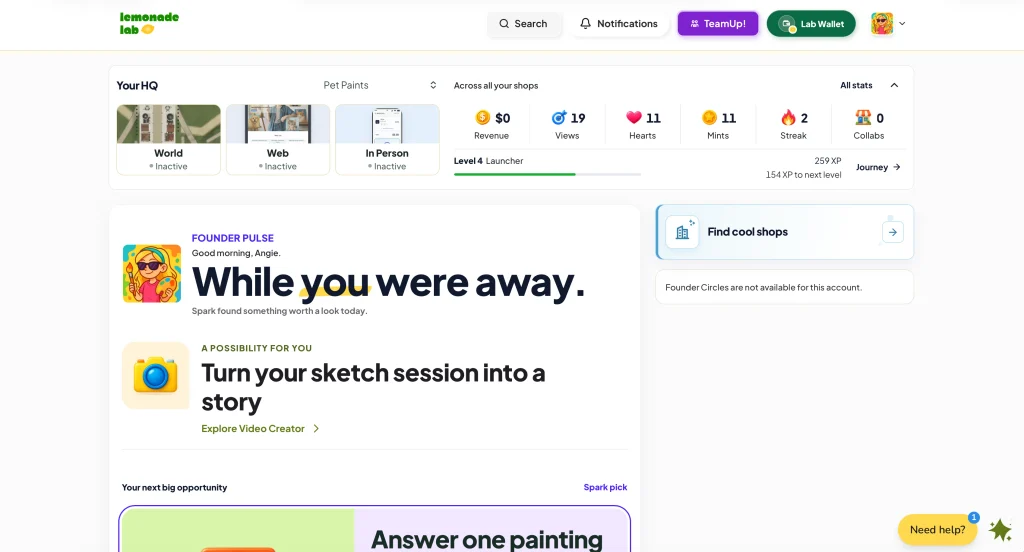
The dashboard supplied to Gen Alpha Magazine shows how projects, activity and creative prompts are brought together in one interface.
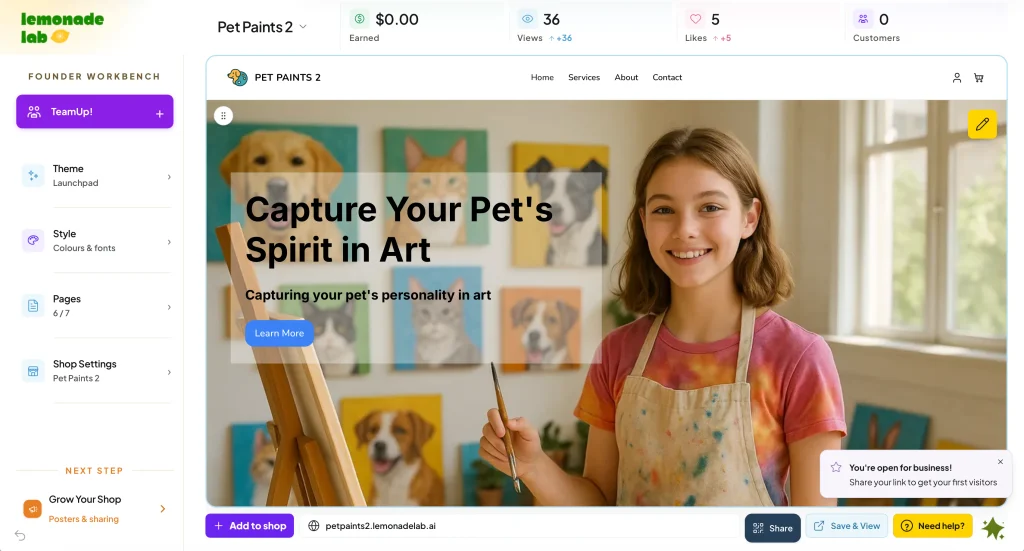
The other screenshot gives us a more concrete example.
It shows a project called Pet Paints 2, complete with pages, shop settings and a storefront centered around pet artwork.
How Does Lemonade Lab Approach Safety and Parental Supervision?
Any platform involving children, AI, communication and real economic activity raises an important question:
How are young users protected?
We specifically asked Horsfield about this.
Gen Alpha Magazine: Because Lemonade Lab involves young users, how do you approach parental supervision, privacy, online safety, and age appropriate participation?
Dean Horsfield:
Parents are part of the architecture, not an afterthought.
Lemonade Lab is designed around parent supervision and age appropriate participation. Important permissions and economic activity are gated appropriately, while the child still gets to feel ownership over what they are building.
We also deliberately limit what AI inside the platform can do and how it interacts with young users.
The goal is not to recreate the adult internet for children.
It is to build a different environment around what young creators actually need.
Lemonade Lab’s published policies provide additional details.
Its privacy policy says that some features may require parent or guardian approval, particularly for users under 13. These can include publicly publishing a shop, selling products or services, communicating with customers, and receiving or withdrawing funds. The policy also states that Lemonade Lab does not sell children’s personal information or use it for targeted advertising.
The company’s safety information says storefronts are separated from protected account information and describes parent oversight, different shop-visibility options, product safeguards and structured customer communication rather than unrestricted customer direct messaging.
It’s also important to note that Lemonade Lab’s own terms say its safety protections cannot guarantee that all harmful, unsafe or inappropriate content or conduct will be detected or prevented. Parents therefore remain an important part of the process.
When Does Entrepreneurship Put Too Much Pressure on Kids?
Encouraging children to make something is one thing.
Turning every interest or hobby into a source of income is another.
We wanted to know where Horsfield draws that line.
Gen Alpha Magazine: When children begin experimenting with entrepreneurship or earning money online, where do you think the line should be drawn between encouraging creativity and placing adult style commercial pressures on them?
Dean Horsfield:
The moment the primary objective becomes maximizing the child’s revenue, I think we have lost the point.
A child can learn an extraordinary amount from making five dollars. They can learn pricing, confidence, communication, customer service, mathematics, creativity and resilience. They do not need the pressure of building a five million dollar company.
We should let kids experience the mechanics of entrepreneurship without importing all of the anxiety and expectations of adult capitalism into childhood.
Success at this age should be measured largely by what they built, attempted and learned.
Money can be part of the feedback loop. It should not become their identity.
This distinction is particularly relevant as the oldest members of Gen Alpha reach an age when some are beginning to think about earning their own money.
How to Make Money as a Teen in 2026: 15 Realistic Ideas
And for teens interested specifically in digital entrepreneurship:
How to Sell Digital Products on Etsy as a Teen in 2026: A Beginner’s Guide
Those guides explore practical earning ideas. Horsfield’s point adds an important counterbalance: earning doesn’t have to become the sole measure of whether a young person’s project succeeded.
What Role Should Parents and Educators Play?
Young creators still need adult involvement.
The difficult part is determining when helping becomes taking over.
Gen Alpha Magazine: What role should parents and educators play when a child wants to use AI to build a project, start a small venture, or create something for an online audience?
Dean Horsfield:
I think adults should become guardrails rather than directors.
There is a temptation to take over when a child’s idea is messy or imperfect. That usually destroys the most valuable part of the experience.
Let them make the strange logo. Let them choose the product you would not have chosen. Let something fail. The parent or educator should help with safety, judgment and perspective. The child should retain ownership of the decisions whenever possible.
“Guardrails rather than directors” may be one of the clearest ways to summarize Horsfield’s philosophy.
Adults remain responsible for boundaries around safety, privacy, money and appropriate online participation.
Within those boundaries, however, children also need enough independence to make decisions—including imperfect ones—and discover what happens next.
Is Traditional Education Keeping Up With AI?
Entrepreneurship is only one part of the conversation.
AI is also changing how children research information, complete schoolwork and demonstrate understanding.
Gen Alpha Magazine: Do you think traditional education is keeping pace with how quickly AI is changing the skills children will need? What skills should schools be placing greater emphasis on for Gen Alpha?
Dean Horsfield:
Technology is moving much faster than education systems were designed to move.
I think we should spend less time asking whether children can produce the correct answer and more time developing judgment.
Can you identify a worthwhile problem?
Can you communicate an idea?
Can you question an AI response rather than blindly accepting it?
Can you make a decision with incomplete information?
Can you collaborate?
Can you recover when something does not work?
Can you turn an idea into something another human values?
AI makes those skills more important, not less important.
The ability to question AI may be especially important.
Generative AI can produce polished and convincing answers that are still incorrect. AI literacy therefore isn’t simply about learning how to write prompts.
It also involves knowing when to challenge, verify or reject an AI-generated answer.
Our ChatGPT for Teens guide explores that issue in more detail.
What Has Lemonade Lab Learned From Kids Already Using It?
Technology designed for children can sometimes reveal unexpected behaviors once children actually start using it.
So we asked Horsfield what has surprised the Lemonade Lab team.
Gen Alpha Magazine: What have you learned from the children and families already using Lemonade Lab? Are there any examples or stories that particularly surprised you?
Dean Horsfield:
The biggest surprise has been how quickly children stop thinking of themselves as children using software and start thinking like owners.
You hear questions like, why are people visiting my shop but not buying? Should I change the picture? Is my price too high? How do I get more customers?
Those are sophisticated questions.
We have also seen that a child does not necessarily need to make a sale for the experience to become meaningful. The act of building something that is theirs changes how they interact with technology.
They become participants rather than spectators.
That shift interests me as much as the businesses themselves.
This is where separating learning from revenue becomes useful.
A shop that earns nothing could still prompt a child to think about design, pricing, communication, customer behavior and problem-solving.
The experiment itself can be part of the education.
Could Starting Projects Simply Become Part of Growing Up?
Today’s children will eventually enter a labor market shaped by technologies that are still developing.
Horsfield believes one possible difference between Gen Alpha and previous generations will be how easily young people can move from having an idea to actually launching something.
Gen Alpha Magazine: Looking ahead five to ten years, how do you think Gen Alpha’s relationship with entrepreneurship, AI, work, and money could differ from that of Gen Z or Millennials?
Dean Horsfield:
I think the boundary between having an idea and starting something is going to become extremely thin.
For Millennials, starting a company was unusual.
For Gen Z, side projects and creator businesses became much more normal.
For Gen Alpha, I think launching ideas may simply become part of growing up.
They may create ten businesses, games, products or projects before they ever have their first traditional job. Some will become companies. Most will not. But that experience changes your relationship with work. You start seeing yourself as someone capable of creating opportunities rather than simply applying for them.
That could be one of the defining economic changes of this generation.
That’s a prediction rather than an established outcome.
AI is developing too quickly to know exactly how today’s children will use it five or ten years from now.
But the declining barrier between thinking of something and attempting to create it is already worth watching.
Dean Horsfield’s Advice for Parents: “Do Not Make It Yours”
Finally, we asked Horsfield what he would tell a parent whose child is excited about AI, technology and building things.
His answer started with four words.
Gen Alpha Magazine: If you could give parents one piece of advice about raising a child who wants to build, create, or experiment with AI and technology, what would it be?
Dean Horsfield:
Do not make it yours.
Give them access to the tools. Give them boundaries. Ask questions. Protect them where they need protecting. But let the idea belong to them.
A badly executed idea that a child genuinely owns is often more valuable than a brilliant idea their parent built for them.
It’s a useful reminder that a child’s first project doesn’t need to look professional.
The strange logo, questionable product idea or first attempt that fails may be precisely where some of the learning happens.
One Final Thought on the “Founder Generation”
After answering all 12 of our questions, Horsfield shared one final thought about his Founder Generation thesis:
“I think we are approaching a strange moment where a twelve year old may have access to more creative leverage than a thirty year old entrepreneur had twenty years ago.
Society has spent a lot of time debating what AI might take away from the next generation. I think we should spend at least as much time asking what it suddenly allows them to create.
That is the opportunity I am interested in.”
And perhaps that’s the most useful way to understand the Gen Alpha Founder Generation idea.
It doesn’t mean millions of children need to become CEOs.
Childhood shouldn’t become a competition to monetize every interest, either.
Instead, we’re watching the range of things children can attempt expand dramatically.
For much of the internet era, children have primarily been treated as audiences—viewers, gamers, users, followers and consumers.
AI and increasingly accessible creative tools give them another possible role:
Creator. Builder. Founder.
The challenge for parents, educators and technology companies is helping children explore those possibilities without importing all the pressure, risk and commercial expectations of the adult internet into childhood.
Whether “Founder Generation” becomes a lasting description of Gen Alpha remains to be seen.
But the question behind it is already relevant:
What happens when an entire generation grows up knowing that having an idea and trying to build it can happen on the same day?
About Dean Horsfield and Lemonade Lab
Dean Horsfield is the founder of Lemonade Lab, a platform designed around young creators, entrepreneurship and parent-supervised participation.
Readers interested in learning more can visit the official Lemonade Lab website.
Parents should also review Lemonade Lab’s current Parent Guide, Safety information, Privacy Policy and Terms and Conditions before deciding whether the platform is appropriate for their child.
Editor’s Note: This feature is based on an exclusive written interview conducted by Gen Alpha Magazine with Lemonade Lab founder Dean Horsfield. Dean’s interview responses have been preserved in their original wording, with minor formatting adjustments for readability. The portrait and platform screenshots accompanying this interview were supplied by Lemonade Lab for editorial use.