
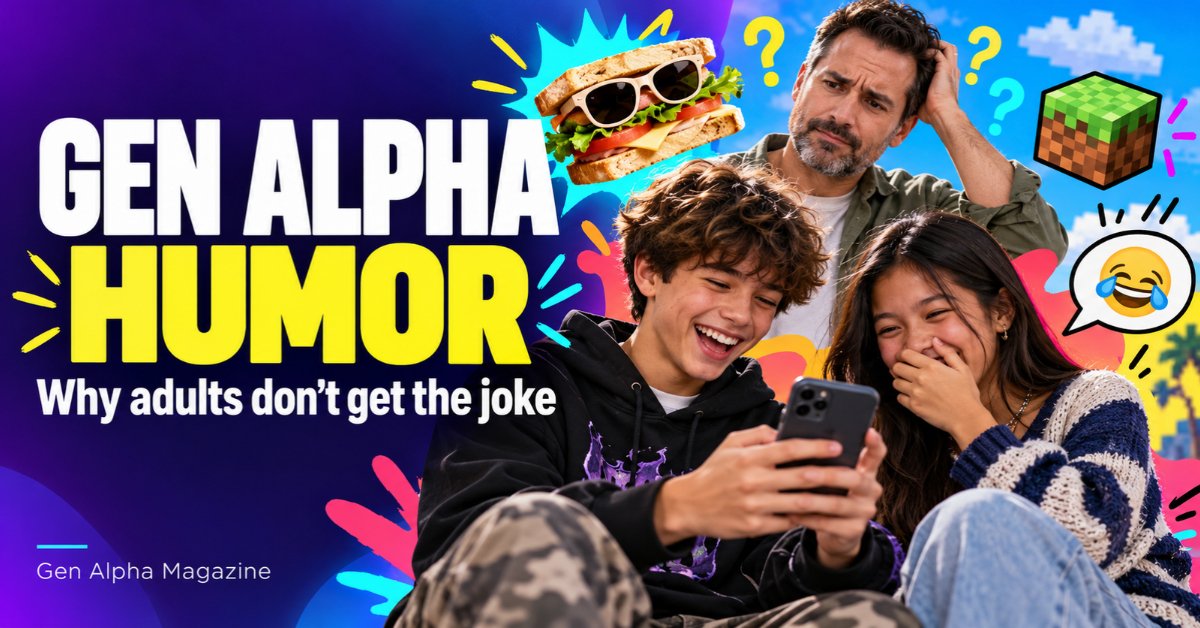
Gen Alpha humor can leave adults waiting for a punchline that never arrives.
A child plays a strange sound. Their friend repeats one word. Both start laughing.
You ask what is funny.
“Nothing,” they say. “You wouldn’t get it.”
Sometimes, they cannot explain it themselves.
But there is often more happening than random noise. The joke may depend on a familiar video, an unexpected edit or a reference shared by friends.
Here is how to understand it without memorizing every meme.
Table of Contents
What Is Gen Alpha Humor?
Gen Alpha humor is a broad label for jokes, memes and comedy associated with Generation Alpha.
It often includes absurd situations, repeated sounds, exaggerated reactions and references to online videos or games.
However, there is no single style that every child enjoys.
Some children love chaotic edits. Others prefer clever wordplay, animal videos, physical comedy or ordinary jokes.
The label also overlaps with Gen Z humor and wider internet culture. Children do not invent or consume memes in separate generational bubbles.
If you are unfamiliar with the generation itself, start with our guide to what Generation Alpha is.
Why Does Gen Alpha Humor Seem So Random?
Imagine watching the final ten seconds of a movie without seeing the beginning.
Something meaningful happens. Everyone around you reacts.
You have no idea why.
An internet joke can create a similar experience. The child watching it may recognize a sound, a character and several earlier versions of the same meme.
An adult sees only the latest version.
That missing background can make a reference look like complete nonsense.
Other times, the nonsense really is the point. An ordinary scene suddenly becomes ridiculous. The surprise provides the joke.
Five Things That Help Explain Gen Alpha Humor
1. Recognition Can Be the Punchline
Not every joke needs a clever ending.
Sometimes, hearing a familiar sound in an unexpected place is enough.
Imagine a child quietly opening a snack. Someone adds dramatic movie music and a caption announcing a major world event.
The action is ordinary. The treatment is wildly excessive.
The humor comes from recognizing that mismatch.
2. Repetition Becomes a Shared Joke
A phrase may begin in a video. Friends repeat it. Then they use it in situations that have little connection to the original.
Eventually, saying the phrase can mean:
“You know the reference. I know the reference.”
The literal words matter less than the shared understanding.
Dictionary.com describes “67,” pronounced “six-seven,” as an ambiguous expression with shifting, deliberately absurd uses.
That is why asking for one exact translation may not produce a useful answer.
3. The Delivery Does Much of the Work
A written transcript can make a funny video look painfully dull.
It leaves out the sudden pause. The distorted voice. The badly timed zoom. The completely serious expression.
Consider someone saying, “That went well.”
The words alone tell you very little.
Now imagine them saying it after a virtual house collapses behind their game character.
Timing changes the meaning.
With some internet humor, the sound or edit carries more of the joke than the sentence does.
4. Deliberately Bad Can Be Funny
Some memes use awkward fonts, rough cutouts or overly dramatic effects on purpose.
The poor presentation becomes part of the joke.
Picture a photo of a sandwich edited like the poster for an enormous action movie.
It does not need polished design to work. The exaggerated effort applied to something unimportant creates the humor.
Of course, a badly made video is not automatically clever. Sometimes a child simply enjoys something an adult finds irritating.
Both reactions can be honest.
5. Friends Build Their Own Meaning
A joke can become funny because of what happened when friends first heard it.
Perhaps someone said a phrase during a game at exactly the wrong moment. Now the group repeats it whenever something similar happens.
The phrase may mean nothing to anyone else.
Adults have these jokes too.
A family can laugh at an ordinary sentence for years because of one holiday disaster. Explaining the original event rarely makes a stranger laugh as much.
Children’s inside jokes work in a similar way.
Gen Alpha Humor Examples Explained
These are illustrative examples. They show how the humor works rather than suggesting that every child uses the same jokes.
| Example | What may make it funny |
|---|---|
| Someone drops a pencil, followed by dramatic disaster music. | A tiny event receives an enormous reaction. |
| A friend says “minus 1,000 aura” after an awkward entrance. | Imaginary coolness points turn embarrassment into a playful score. |
| A familiar catchphrase appears in an unrelated video. | Viewers recognize a reference where they did not expect it. |
| A game character stands still while chaos unfolds nearby. | The lack of reaction contrasts with the situation. |
| An ordinary object gets a dramatic voice and complicated backstory. | Something unimportant is treated as extremely significant. |
For definitions of common expressions, see our Gen Alpha slang guide.
Knowing a word helps. Knowing when friends use it can help even more.
Why Adults Don’t Always Get the Joke
They Have Missed the Earlier Versions
A meme can build on another meme.
One version changes the sound. Another changes the character. A third makes fun of the earlier edits.
A child who has watched the sequence understands what changed.
An adult encountering the third version has no reason to recognize it.
They Expect a Clear Explanation
Adults may ask, “What does that mean?”
But meaning and humor are not always the same thing.
A strange noise can be funny without representing an idea. A facial expression can work without a verbal punchline.
Trying to translate every joke into a sensible sentence may remove the part that made it amusing.
They Are Watching in a Different Setting
A video watched alone at breakfast can feel different from the same video shared among friends after school.
One person starts laughing. Another remembers an earlier joke. Someone adds a new imitation.
The social moment contributes to the experience.
You may understand the video perfectly and still not find it funny. That does not mean you missed a hidden message.
Is Gen Alpha Humor the Same as Brain Rot?
The terms overlap, but they are not interchangeable.
People often use “brain rot” casually for repetitive, absurd or heavily internet-based content. They may also use it when they cannot stop thinking about a particular joke or interest.
Gen Alpha humor is broader. It can include storytelling, playful observations, parody and jokes that have nothing to do with fast edits or nonsense phrases.
Our explanation of what brain rot means explores that distinction.
Another example is “skibidi.” Cambridge Dictionary’s entry recognizes its humorous use, including use without a specific meaning.
An unfamiliar expression alone tells you little about the quality or suitability of the video around it.
Is Gen Alpha Humor Bad for Kids?
A strange joke is not, by itself, evidence of a problem.
A more useful approach is to look at the content, the context and the behavior around it.
Is the joke playful? Is someone being humiliated? Does the child understand a phrase they are repeating? Can they stop when the situation calls for it?
Also separate enjoying a meme from endlessly watching videos.
A child can enjoy an absurd joke and still read, play outside and spend time with friends. Another child may need support with device boundaries.
The joke alone cannot tell you which situation you are seeing.
When “It’s Just a Joke” Is Not Enough
Humor does not excuse targeting someone.
A repeated nickname can become bullying. A joke about someone’s body can cause embarrassment. Filming a classmate’s distress can expose them to unwanted attention.
If the person being targeted asks for it to stop, that matters.
Adults can set a clear boundary:
“You can enjoy the joke. You cannot keep using it to upset someone.”
The same applies to timing.
A phrase may be harmless during a game. Repeating it over a teacher’s instructions is still disruptive.
Understanding the reference does not require accepting every use of it.
How Parents Can Understand Gen Alpha Humor
Start with curiosity.
Instead of asking, “Why would anyone find this funny?” try:
“Is there an earlier video I need to see?”
That invites an explanation without insulting the child’s taste.
You can also ask which part they enjoy. Is it the voice? The unexpected ending? The reference to a game?
Watch the actual clip when possible. A child’s summary may leave out the timing that makes it work.
And allow yourself to remain unimpressed.
A useful response can be:
“I understand the joke now. It’s not my favorite, but I can see why you and your friends like it.”
Parents do not need to perform every trend to stay connected.
Should Adults Use Gen Alpha Slang?
You can, especially if everyone enjoys the exchange.
But repeating a phrase does not guarantee that you will use it the way children do.
That can create a new joke of its own.
A parent announcing “plus 1,000 aura” after finding a parking space may receive a laugh, an eye roll or a request to stop.
Pay attention to the reaction. Shared humor works best when everyone can participate without feeling mocked.
The goal is to understand your child a little better. You do not need to win approval from their group chat.
Frequently Asked Questions
What is Gen Alpha humor?
Gen Alpha humor is a broad term for comedy associated with Generation Alpha. It can include absurd memes, repeated sounds, exaggerated edits and shared online references. Preferences vary widely between children.
Why is Gen Alpha humor so random?
Some jokes rely on missing context from earlier videos. Others deliberately combine unrelated things for surprise. Friends may also attach their own meaning to a phrase that sounds random to outsiders.
How is Gen Alpha humor different from Gen Z humor?
The styles overlap considerably. Absurdity, irony and internet references are associated with both groups. It is more useful to examine a particular meme or community than assume there is a firm generational boundary.
Why do children repeat memes so much?
Repetition can help friends recognize a shared reference. A phrase can also remind them of an earlier funny moment. However, they still need to learn when repetition becomes disruptive or unwelcome.
Does liking brain rot mean a child is unintelligent?
No. Enjoying a particular style of comedy does not establish someone’s intelligence. Concerns about learning or behavior should be assessed through specific evidence rather than meme preferences.
Do parents need to understand every meme?
No. Understanding the general context is usually more useful than memorizing every phrase. Ask questions when content seems confusing, inappropriate or directed at another person.
You Can Understand the Joke Without Laughing
Gen Alpha humor can be noisy, repetitive and difficult to explain.
It can also be a way for friends to recognize each other, play with expectations and make ordinary moments ridiculous.
The next time your child shows you a confusing video, ask what came before it.
You may discover a clever reference.
You may discover that the entire joke is a badly edited sandwich.
Either way, you will know a little more about what made them laugh.